8. X–8. XI 2015
Tallinn Art Hall
Artists: Talia Chetrit, David Claerbout, Daniel Gustav Cramer, Moyra Davey, Haris Epaminonda, Alicja Kwade, Maanantai Collective, Jüri Okas, Ats Parve, Agnieszka Polska.
Curator: Anna Laarits.
I am not sure if it is because – or in spite – of the fact that I can label myself a professional art critic that many of my prejudices from the past few years resurfaced when I visited the exhibition “Time Lapse” at the Tallinn Art Hall. These prejudices are, above all, related to choices artists and curators make and are almost exclusively concerned with the way artworks are presented and not the works themselves.
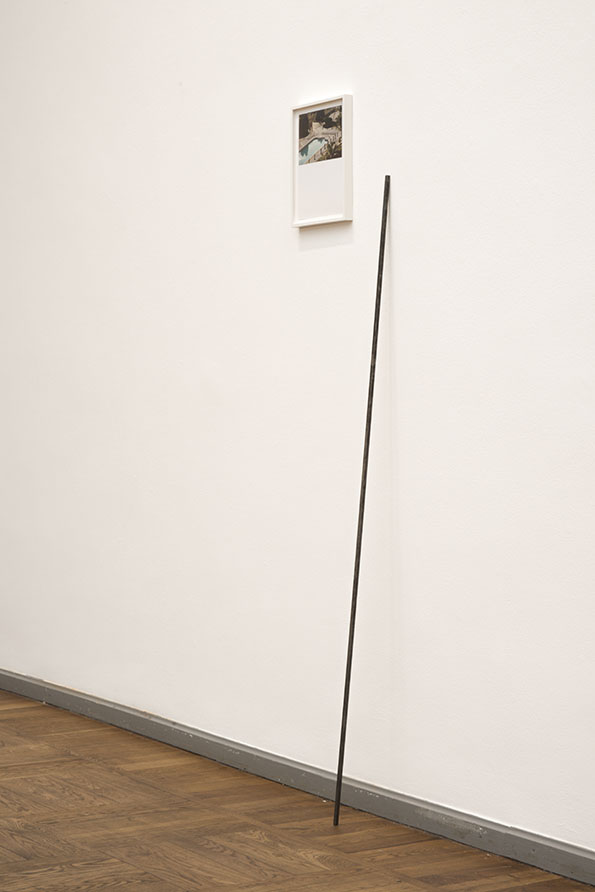
The re-emergence of the aesthetics of classic conceptualism has, on the one hand, brought on modes of exhibiting which, following the tradition, are critical of institutions. On the other hand though, these modes have become new dogmas of their own – for example, positioning a work on the gallery floor so that it rests against the wall, instead of fixing it to the wall. At “Time Lapse”, where a framed photograph hanging on the wall felt like a refreshing exception, one example of such a mode of presentation was Haris Epaminonda’s photograph “Untitled #08 p/q” (2012), placed on the landing of the staircase. The photograph was not only leaning against the wall, but was also half hidden behind a white plinth. Daniel Gustav Cramer’s minimalist installation was exhibited in a similar fashion – the installation itself was made up of an iron rod resting against the wall “IV d” (2014), an iron ball on the floor (“V”, 2013) and two stacks of papers. Also on the floor were photographs of Ats Parve’s series “Nimetada” (To Be Titled, 2015). However, if Cramer was following the canon of minimalism, Parve’s works seemed to be subjugated to the demands of exhibition design.
On the other hand, at times these dogmatic repetitions interfere with content as well. The photograph hiding behind the plinth is a found photograph. A found object as a technique is probably a technique most loaded with meaning, and in recent years it has become extremely popular. The title of Ats Parve’s work, “To Be Titled”, makes the viewer extremely aware of the fact that there are six works at the show called “Untitled”, so its potential meanings are abated by the formal nature of other titles, or, in the worst case, his title becomes a caricature.
Clichés of design affect the works too. In Agnieszka Polska’s video “Watery Rhymes” (2014), a monotonous, emotionless and machine-like voice reads a text – this voice seems to be the compulsory sonic background of contemporary conceptualism. Moyra Davey’s spatial photographs “Of Jane (Green Pipe)” (2014) and David Claerbout’s interactive video on space “Untitled (Man Under Arches)” (2000) exist in a context where “space” is the most used word in international art jargon1 and it is extremely difficult to look at these works without prejudice. Desk lamps in exhibition halls have a similar kind of alarming effect on me as an art critic as do the presence of table fans, although, to my surprise, from this exhibition the latter was missing. We could also ask: where are the compulsory Broodthaers-style palm trees in the exhibition hall? Or why are we not hearing the sweet sound of the carousel slide projector and/or the rattling of the 16 mm film projector?
Behind the scenes
“Time Lapse” was organised as part of the programme of “Tallinn Photomonth 2015”, and stems from a similar connection as the curator exhibition for the 2013 “Tallinn Photomonth”, “Shadows of a Doubt” at the Tallinn Art Hall. That exhibition was curated by Niekolaas Johannes Lekkerkerk, a young curator based in the Netherlands, while this year’s exhibition was curated by Anna Laarits, an Estonian who has studied curating at de Appel in the Netherlands. And another thing worth pointing out, Lekkerkerk was invited to curate the exhibition in Tallinn due to his previous connection with the artistic director of the “Photomonth”, Kristel Raesaar, having met while he was studying curating at the Royal College of Art. Furthermore, if we think about all the designers studying in Amsterdam and all the artists taking part in the HISK programme in Gent, it is not hard to predict which connections in Estonian art will be studied and featured by historians in 50 years time.
In the exhibition’s press release, Kristel Raesaar points to the post-medium condition in contemporary art and presents the show as a conceptual self-reflection of photography, as a view of photography “primarily as a conceptual art form that assumes the medium itself as its subject”. It is probably not wise to delve into the new materialist discussions of how focusing on the medium is post-medium. What Raesaar probably wants to say is that in contemporary art photography goes beyond photographs hanging on the wall. It is, however, unclear to whom this statement needs to be proved.
In Estonian professional art, it is not that common to see photography used in a traditional manner, and based on my personal experience, I would say it has only become popular among artists again during the last five years. So the issue of focusing exclusively on the medium is not exactly something that needs attention within the Estonian context. So the fact that a statement addressing this issue was used to explain the aim of the main programme of “Tallinn Photomonth” both in 2013 and 2015 was and still does irk me somewhat. Which is why I am glad that in addition to this imported issue, the exhibitions are linked by a clear common theme – the relationship between photography and time. Peeter Linnap, the guru of Estonian photography, says all photographic practices are united by shutter speed, the evolution of which has influenced all aspects of photography.2 “To Be Titled” by Ats Parve – a series using various photographic papers that are exposed but undeveloped and unfixed and, depending on the manufacturer, turn a different tone of grey – in this light seems like an essential manifesto; photography is not an art of drawing with light, but with time.
The opening theme of “Time Lapse” is movement. I would like to express my admiration for the exhibition designer Dénes Farkas and his courage to reserve the largest space at the Tallinn Art Hall almost entirely for Daniel Gustave Cramer’s photographic series consisting of eight small images titled “Tales 8 (Miami Beach, Florida, December 2008)” (2009). The rectangular shape of the hall seemingly echoes the trajectory of the man on the phone featured in the photographs, as he walks around a similarly proportioned swimming pool. The way the photographs were placed created an exceptional spatial link between the narrative of the series and the exhibition environment. However, the division of Cramer’s conceptual objects – iron sphere, iron rod and two stacks of paper – between the large hall and smaller space at the back of the hall created a sense of fragmentation rather than a connection between different works.
Daniel Gustav Cramer
Tales 8 (Miami Beach, Florida, December 2008)
2009
8 photos, 25 x 20 cm
Detail view at Tallinn Art Hall, photo by Dénes Farkas
Courtesy of the artist and Sies + Höke and BolteLang
Still, I must admit that the task of the exhibition designer was not a simple one – despite the small format of the works, the lack of space for the exhibition became clearer with each step. Haris Epaminonda’s objects were especially affected, yet paradoxically it was the found photograph on the landing of the staircase that suffered the least. An exemplary exhibition with numerous international artists is excellent as a symbolic gesture, but choosing works that do not demand much due to the lack of space and other restrictions and piling them up in tight quarters ultimately creates the effect of a provincial museum, where only second-rate drawings and reproductions of great artists are exhibited. The same problem haunted the 2011 exhibition “Continuum_the perception zone” by Maria Arusoo, who had just finished her curatorial studies in London, even though her exhibition brought together even more noteworthy artists.3 In other words, it was a schoolwork deserving a grade A, or even A+.
The feeling of everything being constricted is unfortunately not alleviated even by good execution with a strong theme and metaphor as its basis. For example, both Jüri Okas’ conceptual architecture photographs “Vaade aknast I ja II” (View From a Window I and II, 1980) and David Claerbout’s “Untitled (Man Under Arches)” lead to spatial metaphysics à la Giorgio de Chirico. And as such these works function as a continuation of the theme communicated by simple time-lapse photography: a man walks around a pool. Furthermore, as the exhibition reaches a point of culmination, the pool, too, becomes an allusion to metaphysical painting through the way it has been depicted; there is a resemblance to a detective’s view through a camera lens in a crime film.
Considering the wordy official statement, it was surprising to encounter the two more traditional (meaning: framed and hanging on the wall) photographs by Talia Chetrit “Untitled (Street #1)” (2015) and “Untitled (Street #11)” (2015), depicting standing and walking people, that gave off a certain retro-vibe with their grainy appearance and colouring similar to film photography. It was equally surprising to see a likewise unambiguous photograph by the Maanantai Collective titled “Rabbit Hole” (2013), depicting a road plunging into darkness at the edge of the reach of headlights.
After displaying examples of time-lapse photography and before dissolving in the abyss of metaphysics, the exhibition placed its theme, time, into a spatial dimension. Agnieszka Polska’s video “Watery Rhymes” (2014) turned time into a semantic unit, a body of word, of which there is too much to be counted: “I can’t count your body’s words. The body of words.” A more scientific comment was made in Cramer’s “Untitled (Carte du Ciel II)”, which depicts, as evident from the title, a piece of the map of the sky and is said to be homage to the ambitious project from 1860 to photograph all the stars. After 70 years, the project was abandoned, since there were just too many stars. These examples make it clear that time is measured by units of space – a minute is the distance that the hand of your watch passes through: which is why the common assumption – that the attempt to cartograph, catalogue and archive everything is prompted by the desire to know all – is untrue. Instead, omnipotence can be found in an immortality that can be achieved only through a definitive stapling down of space, which would also stop the flow of time.
One of the most common symbols of the inevitable cyclical flow of time is the mirror, which, through the flip along the left-right axis, does not even allow the identical to ultimately be identical. In Alicja Kwade’s work mirrors are as significant as clocks. So her line of desk lamps placed in front of mirrors titled “Parallelwelt II” (Parallel World, 2009/2015) is the exhibition’s last venture to shed light on the theoretical question of what we will encounter on the other side, before it brings the viewer to Claerbout’s poetics of metaphysical arches as the supra-sensuous inevitability of experiencing time mentioned above.
Conclusion
Putting the exhibition in a somewhat broader context, I would like to recognise “Tallinn Photomonth” and its artistic director Kristel Raesaar for putting together a balanced, dense and professional programme. As in 2013, this year’s exhibition in Tallinn, dedicated to contemporary photography, was also accompanied by a show in Tartu, introducing the recent history of Estonian photography, as well as a whole array of group and solo shows that cannot be said to have been homogenous. On the contrary, “Tallinn Photomonth” with its additional programme is one of the broadest art events in Estonia.
The programme of studies in curating and gallery management promoted by the Estonian Contemporary Art Development Center has come to fruition, which is good, because we have been lacking professional curators in Estonia. However, at the moment there is no alternative to this programme, so I am afraid the current situation leads along a path without much diversity. So we can only hope the programme of curatorial studies to be opened by the Institute of Art History at the Estonian Academy of Arts will focus in another direction or will be able to create a broader network of contacts.
Indrek Grigor is a semiotician, art historian and critic. He works as the gallerist for Tartu Art House.
1 Alix Rule & David Levine, International Art English. – Triple Canopy, Issue 16, Published from May 17, 2012 to July 30, 2012 (https://www.canopycanopycanopy.com/contents/international_art_english).
2 See: Peeter Linnap, Fotoloogia. Tallinn: Jutulind, 2008.
3 Indrek Grigor, Kontseptualism provintsiaalmuuseumis. – Eesti Päevaleht 6. VIII 2011.