8. VIII–6. IX 2015
Contemporary Art Museum Estonia (EKKM)
Artists: Peeter Allik, Allan Hmelnitski, Mati Karmin, Raivo Kelomees/Sven Kivisildnik, Eve Kiiler, Hasso Krull, Andrus Kõresaar, Marco Laimre, Ly Lestberg, Peeter Linnap, LU:K, Piia Ruber, Piret Räni, Rühm T, Ene-Liis Semper, Hannes Starkopf, Jaan Toomik, Mare Tralla, Tarvo Hanno Varres, Mart Viljus, Toomas Vint, Jasper Zoova.
Quotes: Jüri Arrak, Ants Juske, Kreg A-Kristring, Hasso Krull, Mari Kartau, Kalev Kesküla, Eha Komissarov, Jüri Kuuskemaa, Peeter Linnap, Linnar Priimägi, Johannes Saar, Toomas Vint, Märt Väljataga.
Curators: Anders Härm and Hanno Soans
Consultant: Marco Laimre
The exhibition of art from the 1990s at the Contemporary Art Museum Estonia (EKKM) materialised faster than usual, noted Anders Härm, one of the curators of the show (the other curator being Hanno Soans) in his speech at the opening. No wonder – the curators’ own personal experience with the art scene of the 1990s as students serves as a preface to the exhibition. And the topic itself is so well worked through that this show is now the fifth or sixth round of discussion.
Popular nineties
While no one has even started putting together an overview of Estonian art from the beginning of the 21st century, the 1990s are still popular. Let us recap. The first attempt to conclude Estonian art of the 1990s was with the exhibition “Freedom of Choice” at the Tallinn Art Hall in 1998.1 The aim was to create a positive image of art, which had become an underdog in Estonian society. It presented the artists’ success stories. It asked what were the most significant changes in comparison to the art of the 1980s; in other words, the Soviet period. Among other things, the exhibition tried to calm the audience down, although the result was exactly opposite – the audience became even more anxious.
The next institution to address this issue was the newly finished Kumu.2 In 2006 to 2007 an extensive two-part show titled “Collected Crises” took place in the large gallery on the 5th floor of the museum. The exhibition displayed an extensive variety, “all kinds” of works, including those people, who were part of the 1990s art scene, do not remember ever having seen. The list of artists and works at that exhibition was extremely long, one could assume the short-lived project was supposed to make up for the fact that even to this day Kumu does not have a permanent exhibition dedicated to contemporary art. Now Kumu has displayed more of the art of the 1990s, but with a focus on more specific issues. For example, Hilkka Hiiop, an art conservator working at Kumu, discussed the complicated issues of renovating and conserving in relation to art from this specific period in 2012 in her PhD thesis and exhibition.3 Kumu’s exhibition “Death and Beauty. The Contemporary Gothic in Art and Visual Culture”4 was too eager to label the selected works from the 1990s as “gothic”.5 The exhibition titled “HUH? PHOOEY! YUCK! OH! WOW!” curated by Rael Artel at the Tartu Art Museum did sort out some of the traumas of the 1990s6 and drew parallels to works by younger artists working today. Maybe this year’s “1995” at EKKM tries to follow a similar direction; however, the younger generation artists are not included.
When it comes to research, a collection of essays in both Estonian and English titled “Nosy Nineties” was also published.7 In addition, there have been numerous BA and MA theses – maybe soon even a PhD thesis – written in universities (Estonian Academy of Arts, Tallinn University, University of Tartu), and many articles and chapters in other publications. So, the nineties was a passionate period, and by now it has become an equally passionate topic both for reflection and academia. Now, let us ask what is new or different about the exhibition at EKKM in summer 2015 and what were the starting points.
The Saaremaa Biennale and “Interstanding”
First of all, the curators Anders Härm and Hanno Soans define the whole decade through one year –1995 – by stating it was pivotal in many ways. Maybe it was, considering this was the year both the self-initiated Saaremaa Biennale and the conference “Interstanding” organised by the Soros Center for Contemporary Art (Center for Contemporary Arts Estonia since 1999 – ed.) took place. In the Estonian context both were huge events, born out of the efforts of artists and art theorists. At the time, those two large events were opposites. In hindsight it all makes sense – while the Saaremaa Biennale turned its gaze towards the past and analysed history and political taboos, “Interstanding” was looking to the future and analysed technological utopias.
At the time, as opposites, these two points of view seemed unable to fit within the same art scene. The conflict over finances was hardly the only reason. The people and their working positions behind the two events differed, the theoretical standpoints and books they relied on must also have been in conflict. “Interstanding” was based on a Modernist and progressive view of the world and a corresponding techno-utopia and its critique; the Saaremaa Biennale, on the other hand, used the archaeology of history and post-structural critical theory as its tools. Essentially, one exercised power, the other criticised it. But as “Interstanding” never published a catalogue, this topic is missing from “1995”. Instead, it features the annual exhibitions of the Soros Centre for Contemporary Art, like “Biotoopia” (Biotopia, 1995) and “Olematu kunst” (Non-existent Art, 1994), which showcased the works of Estonian artists and were, of course, related to “Interstanding”.
From troubleproduction to doubleproduction
The curators of the show at EKKM, Anders Härm and Hanno Soans, formerly known as the young male artist and art critic duo troubleproductions, most likely had strong personal preferences when it came to the decade in question. Nevertheless, they have decided to take a more academic route and exhibit works that would not necessarily fit their own liking, such as the painting by Soviet era artist Toomas Vint.
Furthermore, I would like to point out that while at the beginning of the 2000s, troubleproductions proudly disregarded history8, these art theorists, who grew up in the 1990s, suddenly felt the urge to work with recent (art)history. And what is even more important and new in their recent work – they do not take sides. Since this is their “own” history, making jokes about history in the style of the Young British Artists (yBa) à la interpreting the famous and incomparable painting by Johann Köler “Truu valvur” (Faithful Guardian, 1878), which hangs in Kumu Art Museum, through Vladimir Nabokov’s character Lolita seems to be out of the question.9
The curators have decided to ignore the wealth of research and interpretations of 1990s art that already exists. As it becomes clear, their research was mainly about working through the catalogues, television programs and articles of the time, which are used as reference material selectively. (Six catalogues and a collection of essays are displayed at the museum’s café.10) That is, the research meant sifting through primary sources and looking for ideas, based on the question: where are there links to the art of today? Or, what ideas, aesthetics, choices and topics from the mid-1990s are relevant in 2015, both in terms of art and artists and the next generation?
On the three floors of EKKM this is how the works are grouped: the exhibition starts off with a selection from the Saaremaa Biennale “Fabrique d’Histoire” and its student show “Artel of History”; then there is feminism; then Jaan Toomik; another hall is dedicated to journalism and media as the basis for art; a small room of discussions; and finally pop culture and music and drugs.
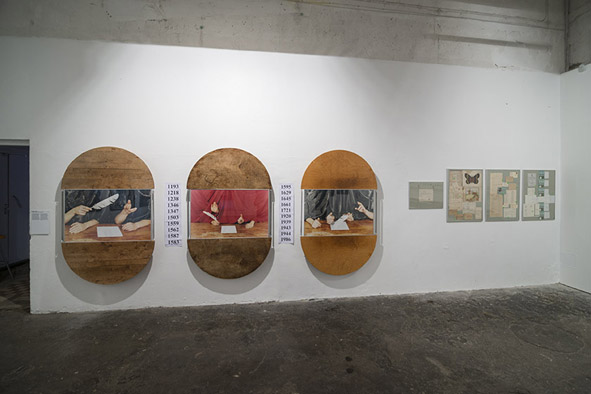
Marco Laimre
Divided Territories
1995
installation
Courtesy of the artist
Exhibition view at EKKM
Photo by Johannes Säre
Distortions
In some ways “1995” is a mission impossible. Distortions are caused already by the fact that both the Saaremaa Biennale and “Interstanding” were international events – in addition to Estonians, many artists and theorists from other countries also participated. The current exhibition focuses exclusively on Estonian art and dismisses the international works, unobtainable for display anyway. This international quality can only be marked by an art television program of the time, which functions as a “canned” documentation, and is, of course, interesting to watch (again).
The 1990s are a great example of Jean-François Lyotard’s idea of a lack of consensus in a “postmodern situation”. Even though in the early 1990s, Lyotard was considered a key author at the Central European University founded by Soros, in Estonia he was rarely thought to be that significant. Now, finally, a book by Lyotard has been published in Estonia, “The Postmodern Explained to Children”, first published in 1986, but only translated into Estonian in 2014.11 And knowing the current mindset of the artworld – it is highly doubtful anyone here is going to read it.
Other deformations are actually caused by the fact that after the monolithic theoretical platform of the Soviet Union collapsed at the end of the 1980s – since Marxism-Leninism was the only theory officially allowed – many theories from the West found their way to this seemingly empty space. Local theorists and artists each read “their own” authors and ended up fighting because everyone was so used to the Soviet mindset of only one theory being the “right” one. Even worse, as soon as the Western adaptations of Marxism and Leninism took root in Estonia, whether through feminism or critical theory, an active lack of consensus among art people was guaranteed. All of this is exemplified by a television program in which Ants Juske, Peeter Linnap, Jüri Arrak and Linnar Priimägi are having a discussion, while each of them has a different point of view. The “winner” is the one more agile with words, more charismatic and quicker to put his foot down.
So, “1995” wants to be a study that features essential television material, articles and quotes representing different viewpoints. The hall of feminist theory and art does not seem to be as strong as the other groups of works. Even though it is the works of “the mother of Estonian feminism” Mare Tralla that dominate here – her key piece “Nii me sünnitasime eesti feminismi” (So We Gave Birth to Estonian Feminism, 1995) is more a kind of backdrop. Instead, the emphasis is on her rarely seen poetic video installation that was unknown to many even during the 1990s (a work in which she and Jaan Toomik stare at each other via video monitor). At the same time, this work is highly atypical of Tralla.
My absolute favourite at the exhibition is the hall of media and journalism: Peeter Allik’s report-like paintings, a video by Raivo Kelomees and Sven Kivisildnik, Jasper Zoova’s commentary on the Moscow news programme “Vremya” and Mart Viljus’ newspaper manipulations. In the 1990s, people lived in the present, not in “eternity” as in the Soviet period when everyone mentally tried to escape the present. Today, it seems, it is quite the opposite – mentally people escape eternity.
In conclusion
I would still like to ask who would see the exhibition as their own? Not many artists or art theorists whose works were exhibited came to the opening of “1995” on 7 August. However, who did come, were many of the artists represented at the Saaremaa Biennale and its satellite exhibition “Artel of History”. Could we say that this event from 1995 is actually what triggered the whole exhibition? The people who were students at the time had such a powerful international experience that they still draw strength from it? Ideas-wise, the whole of EKKM as an institution is derived from this experience. So maybe EKKM used the exhibition to sort out its own identity and history?
Heie Treier is an art theorist and critic and a docent of Art History at the University of Tallinn.
1 Anu Liivak, Heie Treier (eds), Freedom of Choice. Perspectives on Estonian Art of the 1990s. [Exhibition catalogue. Tallinn Art Hall 16. II–15. III 1998.] Tallinn: Tallinn Art Hall, 1999.
2 “Collected Crises. Estonian Art in the 1990s”. Kumu Art Museum 7. VII 2006–5. II 2007. Kuraatorid Eha Komissarov ja Hanno Soans.
3 Hilkka Hiiop, Contemporary Art in the Museum: How to Preserve the Ephemeral? The Preservation Strategy and Methods of the Contemporary Art Collection of the Art Museum of Estonia. Tallinn: Estonian Academy of Arts, 2012.
4 “Death and Beauty. The Contemporary Gothic in Art and Visual Culture”. Conteporary Art Gallery on the 5th floor of Kumu.20. II–10. V 2015. Curators Eha Komissarov and Kati Ilves.
5 Heie Treier, Mürgitatud ilu. Küsimusi näituse “Surm ja ilu” kohta. – Sirp 10. IV 2015.
6 Heie Treier, How to Clear the History of Art from Traumatic Metaphors. – KUNST.EE 2012 (4), 2–9.
7 Sirje Helme, Johannes Saar (eds), Nosy Nineties. Problems, Themes and Meanings in Estonian Art on 1990s. Tallinn: Center for Contemporary Arts, Estonia, 2001.
8 E.g. see: Anders Härm & Hanno Soans (troubleproductions), Niipalju siis järjepidevusest ehk Miks teatriliit ei ürita Draamateatris näitemängu teha. – Sirp 4. IV 2004.
9 Anders Härm, Lolita and the guarded subconscious. Johann Köler’s “Faithful Guardian” (1878). – Estonian Art 2001, no 1, pp 30–33.
10 These are the catalogues of the following exhibitions: “Self-Portrait” (Moscow 1995), “Biotopia” (1995), “Fabrique d’Histoire” and “Ajaloo artell” (1995), “Unexistent art” (1994), “Est.fem” (1995). Additionally a collection of presentations from the conference “Changes in Art and Understanding It” is displayed (materials of the autumn conference of the Tallinn Art University and AICA Estonia, 1994–1995, published in 1996).
11 Jean-François Lyotard, Postmodernsusest lastele. Kirju aastatest 1982–1985. Tallinn: Tallinna Ülikooli Kirjastus, 2014.
Quote corner:
“But what did happen in 1995? The Singing Revolution was over, the August Coup long forgotten, the Russian troops had left, the cruise ferry MS Estonia had sunk, Kurt Cobain was dead. No, nothing too tragic or dramatic happened that year. Or did it? At least in the art scene 1995 was exceptional. It is the year between the return of the Tallinn Art Hall and the opening of the exhibition hall of Art Museum of Estonia at the Rotermann Salt Storage. The first Saaremaa Biennale took place, Jaan Toomik participated at the exhibition “ARS 95” and proved Estonian artists can be internationally successful, the conference “Interstanding” focusing on new media in contemporary art was organised, during the show “Est.Fem” Estonian feminist art was born, the first self-initiated artist-run-gallery (mobil) galerii was opened, the Estonian Cultural Endowment started functioning and allocated its first stipends, Toomas Vint, Linnar Priimägi, Märt Väljataga, Ants Juske, Peeter Linnap and many others began their years long and unfruitful discussion from conflicting positions over “proper” art.”
Anders Härm and Hanno Soans, press release by EKKM 4. VIII 2015.