9. V–22. XI 2015
Giardini, Arsenale, Venezia
The Grand Hôtel des Bains from the times of the Belle Époque in Lido – the building that was featured in Thomas Mann’s short story “Death in Venice” (1912) and in Luchino Visconti’s film of the same title (1971) – is a great example of art increasing the value of real estate, a space or place. It is highly doubtful anyone would otherwise notice the building today. The hotel has been closed for years, the dark ghostly windows have been covered with boards, there is no sign of the advertised renovations. On the Montenegro side of the Adriatic Sea the real estate bought up by Russian capital is caught up in the wheels of time and the changed market situation and is in a similar state, maybe even worse. If money talks, albeit briefly, when calculations of profit appear, only art can survive beyond its time.
From 13th to 17th century, the city state of Venice was like London or New York today, the centre of commerce and finance, the absolute centre of usury (banking), and as a naval state it was also a military force to be reckoned with. It is our luck that the nobility of Venice invested part of the riches they acquired via trading, warmongering, violence and plundering in advancing art and material culture. In Venice one feels each day is like a gift from god, the slowly sinking pearl, full of countless treasures of architecture and art is like a blessing to humanity. This city places us all in an entirely new context, it tests our strengths, reveals mutiny against beauty and at the same time persuades us to form secret pacts, pushes us to treachery – Venice’s face is the same as the art world’s, Venice is a mirror. Venice was cosmopolitan and international already when the rest of Italy was still a closed off agrarian area.
The parliamentarian principle
The slogan of the 56th Venice Biennale, “All The World’s Futures” created by the principal curator Okwui Enwezori (b 1963) focuses on the future, yet unsurprisingly directs our gaze into the past – if you want to predict the future, dig in the past. As anticipated, Enwezori is not that invested in innovations of form when it comes to art of the past decades, instead he is more interested in the social context of various art political developments. The first sections of the curator’s exhibition at the Giardini and the Arsenale have probably never presented current events in such a narrative manner – Fabrio Maur’s suitcase towers (war refugees and illegal immigrants) with stairways to heaven and Oscar Murillo’s rows of black flags (a reference to the Islamic State?) on the facade of the central pavilion of Giardini make the state of mind of 2015 clear even to those visitors who have only seen the evening news.
The history of the Biennale begins in 1895 – at the 120-year-old Venice Biennale there is even a wall of photographs at the Arsenale displaying VIPs visiting the event. The progression of 20th century styles is essentially the story of the white man’s art, which, as mentioned previously, was not the focus of the curator (although a couple of national pavilions, including the United Arab Emirates, had presented a report on the development of Modernist art in their own countries; however, what spoke louder, were the things that were not shown or thought to be impossible to show).
As seen in the previous major exhibitions curated by Enwezori, like the 2001 documenta in Kassel and the 2012 Paris Triennale, he is more interested in cultural anthropology and sociology. And also creating possibilities for artists from the so-called Third World, including countries, territories and the artistic practices of which visitors like me with a Eurocentric background had no previous knowledge. A considerable amount of debutants have been placed on the map – of the 136 artists an astounding 89 are exhibiting at the Biennale for the first time, for many it is their first show outside their home region. The parliamentarian principle of representing different forms and modes of art the curator discusses in the accompanying text has left the Western world a minority. With “slanted” methods the curator, originally from Black Africa, has brought long awaited renewal and new energies to the Biennale.
Continuing on the path of being not politically correct, it could be said that artists from Europe and North America were welcomed to the club only if they were A-category superstars. Like the pioneer of performance and video art Bruce Nauman, whose neon slogans opened the exhibition at the Arsenale or the German premier league painter Georg Baselitz whose gigantic (still upside down) series of “the white man’s journey of sufferings” had been placed in a labyrinthine hall with black walls in a prominent position at the beginning of the Arsenale exhibition, where most of the visitors’ senses are still alert. As a painter, seeing top painters at major curatorial exhibitions I always feel like I have been given an XL-size portion of strawberries with whipped cream, I enjoy it tremendously, but… you cannot have too many at once. As Enwezori interprets it, painting is an extremely emotional artistic text that allows emotions to run free, and as such painting was presented as counterpoints throughout the exhibition.
Painting has made such a strong comeback internationally that one has to be blind not to see a fundamental change in contemporary art – a non-personal technological art is not the subject of this Biennale. In art, manual skills are enjoying a renaissance, among them drawing; but no Möbius-strip-like automatic pencil work or automatic crosshatching. Old fashioned drawing – like what Valli Lember-Bogatkina or Evi Tihemets did in the 1950s, when they depicted the friendship of all Soviet people – is in again! Draw if you can (for example, the South African artist Joachim Schönfeldt’s visual reports at the Biennale)!
The fact that so much art from Africa was exhibited gives a new context to Chris Ofili’s (UK/Trinidad) chapel painted in greyish tones with easel paintings hanging on the walls – comparable to an ethnographic display. Peter Doig, an artist who relocated from London to Trinidad, cannot be found in the “display on artists from all over the world”, instead you have to seek out the tiny Palazzetto Tito on Dorsoduro where a compact exhibition of his newest work, both really large and small, is on show.
Cy Twombly’s retrospective in Ca’ Pesaro or Sean Scully’s exhibition at Palazzo Falieri in the form of a satellite project – that is far from all of the painting the Biennale or its satellites have to offer. Marlene Dumas’ rows of skulls at the Giardini are as masterful as they are democratic – in the face of death we are all equal, and at a certain level of generalisation a skull can say something about us all, so the series as a whole can be seen as a portrait of the portraits of humanity.
The context has changed so much that even artists without a background in painting have started doing it. For example, the American conceptual artist Jenny Holzer who presented her new exhibition “War Paintings” of laconic facsimile-images painted and printed in black and white (serigraphy on canvas) at the Correr museum. Even the famous English musician Brian Eno titles his soundscapes, created in collaboration with Beezy Bailey, as paintings of sound.
How to keep the facade intact
What made the Biennale so special was the harmony between the curator’s project in the Giardini and the 29 national pavilions, and similarly there was a flowing continuity between the curator’s exhibition at the Arsenale and the 31 national exhibitions. Only the Italian national pavilion Codice Italia at the end of Arsenale stood out, but not in a good way. Strong artists, from the leading painter of the trans-avantgarde Mimmo Paladino to Jannis Kounellis and the guest-starring William Kentridge, were packed into a row of massive claustrophobic mausoleums following the aesthetics of the white cube. The presence of the Italian Ministry of Culture and the Catholic Church (for example, in the canonical works of Nicola Samori) in guiding cultural policy became evident here, said many critical Italian voices. In his text Enwezori calls the biennale – and I am paraphrasing here – a unique screen or filter through which to look back on the biennale’s 120 year history and investigate the state of affairs in their essence and “as they appear”. I think it is the latter that has been chosen for the Italian pavilion, despite the high-sounding accompanying text (by curator Vincenzo Trione).
The use of the word “research” in the context of contemporary art is often a great overstatement; art is more like source material that allows us to investigate reality, especially society and mentalities, from an historic distance. Old documentary photographs can be used as such source material, even if they were taken as a means of propaganda. Various artists have staged compositions that bring to the Biennale the Third Reich (Adrian Piper), the Cuban Revolution (a country whose search for its “own path” is coming to an end) and the United States of America, the country with the strongest economy in the world, that was shook by the economic crisis of the 1930s (Walker Evans). For example, the suggestive photo series taken in the prisons of the southern states of the US in the 1980s seems to model the de facto forced labour of the black people in 1980s Louisiana.
Although in politics, Russia seems to thrift towards totalitarianism, in culture they know how to keep the facade intact. On the ground floor of the pavilion, painted black by young architects, a multiscreen video installation by Irina Nakhova (Russia/USA) was displayed – a quality of conceptualism associated with dissidents (solid proof!). The surreal and enormous video and 3D installation of a test pilot on the mezzanine effortlessly made a lasting impact, the Russian pavilion just works!
There is no point in discussing the new video installation by AES+F shown at a satellite exhibition in Dorsoduro: “Inverso Mundus” (2015) was not nearly as violent as the first videos by the group. The focus was still on model-like metrosexual and strangely angelic looking boys and girls and sharp social satire of brands, branded clothing, gender equality, the old and the young etc. However, it is addressed to no one, it is safe, sterile and requires nothing from the viewer. It may be unfair to the artists, but AES+F as a symbol of (mass)culture in Putin’s Russia is really similar to Polina Gagarina who represented Russia at the 2015 Eurovision, and in the West both are considerably more effective than a thousand tanks!
Ukraine whose expositions were supported by the Victor Pinchuk Foundation (a multimillionaire art patron, the Ukrainian Charles Saatchi) had built a transparent, minimalist and extremely vulnerable glass pavilion on an embankment near the Arsenale, the architecture of which was already symbolic on its own and this effect was elevated even more by the title “Hope”. The emphasis was on very young artists who had started their careers after the 2004 Orange Revolution.
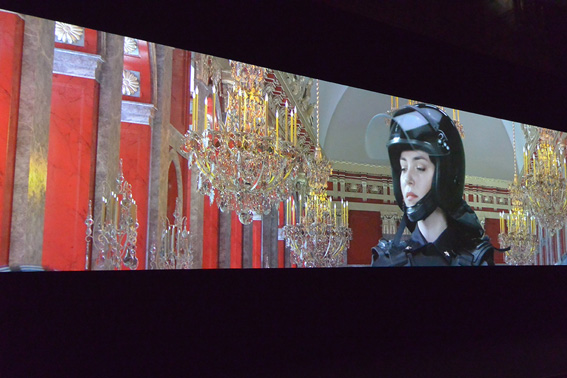
AES+F
Inverso Mundus
2015
7-channel HD video installation
Courtesy of the artists
Photo by Jaan Elken
Putting the history of small nations on the map
Through our unique experience, Estonia, Latvia and Lithuania have started feeling increasingly confident at the Biennale when it comes to cultural policy. The recent history of Estonia and the other Baltic states offers a wide range of subject matter, being more dramatic, curious, full of contrasts and didactic than any kind of fiction. As a small nation we seem to be obligated to place ourselves on the map through art, especially now, in an art politically favourable situation where the use of historic facts and documents is more a rule than an exception. By comparison, German art for example, after years of trauma and rewriting (and after the artists who became well-known through that process), has only now begun to breathe more freely and feel liberated from the agony and guilt over the actions of the Third Reich. Unlike Russia, for example, who has no regret or shame about what they have done.
In the Lithuanian pavilion, Dainius Liškevičius exhibited archival materials (books, records, everyday items and all kinds of products mapping the worlds of both body and soul in their grandeur and misery), which presented our shared Soviet past with the precision of a surgeon’s knife. It also included an episode from 1985 when a mentally unstable Lithuanian dissident organised an acid attack on Rembrandt’s “Danae” (1636) in the Hermitage.
The Latvian artists Katrīna Neiburga and Andris Eglītis managed to produce a pan-regional project for the Latvian pavilion (which, by the way had an extremely good location at the Arsenale) – it focused on the “secret lives” in Soviet garages, yet this is not happening only in Eastern Europe, in a slightly different form the same is going on all over the world, even in the garages of private houses in wealthy countries. These tiny workshops have become territories where men who feel discouraged in the computerised and feminised world can still be in charge of their work and find an outlet for their desire for repairing and tinkering. Fiddling with old car parts and appliances can be a lifestyle or a substitute activity for someone out of a job, but it could also be a conscious choice to step out of the cycle of consumption. The project itself was more uniting than excluding – the installation and the extremely comfortable cinema chairs contributed to an air of elegant carelessness, well integrated with the landscape of sheds built out of discarded boards, and the mobile carne was like a cherry on top.
Jaanus Samma’s project “NSFW. A Chairman’s Tale” was lacking this kind of careless elegance – the ready-mades exhibited in glass display cases and the display of pseudo documentary photographs was a little too clean and dry – some kind of twist in the presentation could have added to the content as well. The video works, especially the painted backgrounds in front of which fully clothed actors performed movements to mark homosexual acts were the strongest part of the exhibition. The significance of the chair, theatrically covered with red velvet, which has been exhibited in Estonia as well, has been reduced in the context of this exhibition. But if I were to honestly judge, I would say this is the strongest Estonian exhibition at the Venice Biennale, more so than the exhibits of Kristiina Norman (2009) and Marko Mäetamm (2007).
Samma’s arbitrary handling of facts and use of a fictionalised visual does not change the fact that the object of his investigation is the Soviet regime that ruled very real consequences. We should have more of this kind of art that interprets the past through fiction and/or fact – the viewers will recognise what has been added as a guiding piece of fiction and what is fact. Maybe it really is the task of the artist in society to bring light to our history through intriguing artistic generalisations, and perhaps even earn their right to exist in the process (because our historians only produce dull collections of facts)? Or does that sound too Soviet? When our (own) writers are not capable of it, Sofi Oksanen from Finland comes and does the job for us, but in art, due to his personal motivations and his role as an activist for the LGBT community, Jaanus Samma has found a burning subject to dissect.
It seems that political correctness won the Armenian pavilion the award. The genocide Turkey inflicted 100 years ago forced a large part of the small nation to emigrate, so members of the displaced Armenian community from all over the world, among them many famous artists of Armenian origin were asked to participate. In a multicultural age, the emigration caused by this tragedy has been put to work to create something positive and the Armenian people found their way around the world much earlier than our borders were opened.
Brazil managed to pleasantly surprise – at this Biennale the large country broke out of its creolised position in relation to the countries of Latin Europe for the first time and addressed its own social stratification. Bearna Reale’s video of a torch bearer “Americano” (2013) presented a great fable. André Komatsu’s installations with wire fencing evoked the criminally inclined urban jungles of São Paulo. Antonio Manuel’s walls and architectural constructions with “class divisions” inspired by the favelas were also lusciously colourful and very beautiful – proof that art with social capacities does not have to be ugly.
Mother Nature
The faith in progress is strong and no one doubts that the choices made were right after all; there is an existential dread and understanding that somewhere a critical line exists and crossing this means catastrophe. Or maybe the line has been long crossed? These questions seem especially relevant in Venice, where the line has been crossed and destruction is imminent, according to marine ecologists and geographers. And so the cruise ships continue coming from the Mediterranean, navigating the archipelago in full gear (the impact of which is evident when looking at the movement of gondolas, but considering other damage, this seems almost the least destructive). On board these ships are the wealthy “two day tourists” from North America, Japan and elsewhere, but also the leaking sewage pushes huge amounts of waste into Venice’s closed ecosystem (mud, islands, currents, fish, plankton, bacteria etc.) and that has blocked its natural ability to purify itself. The quality of the water has disintegrated even further due to the extremely dense 24-hour traffic of watercraft (hundreds of ferries, dozens of vaporetto lines, as well as scooters and water taxies) and the residue of fuel that inevitably ends up in the water.
Tuvalu – I have heard of this country located among coral islands, and which became independent from the UK in 1978, in connection to its possible future disappearance into the depths of the ocean. The Tuvalu pavilion displayed the work of J.F. Huang – a steaming surface of water at the very end of the Arsenale, inside the pavilion. It is possible to cross it using a plywood surface resembling a pontoon bridge – I had to balance myself and my toes got wet, but I did get to the other side of this Taoist water challenge, although I felt like a puppy whose nose has just been pushed into a bowl of milk. Nature and water have been brought to pavilions not as a resource for humanity and not even as our “partner”, but as one of the most important elements that allows us to exist on this planet – the curator’s concept does not spell this out explicitly, but it is evident from the works.
The exceptionally popular Swiss pavilion just at the beginning of the Giardini’s “main boulevard” (Russia, Japan, UK, France, Scandinavia etc.) displayed a pseudo product catalogue, which referred, together with the title “Our Product”, to the beauty industry. The subtle beauty really did become visible, as the pink lagoon water and its greenish shadows flickered in the glass ceiling and walls of the pavilion – so the whole masquerade hinted at the sinister beauty of industrial waste, or at the cost of beauty, to be more precise. And all that without an unpleasant smell and direct contact with “negativity”, everything was so charming that the viewer, trained to have a bipolar way of thinking about art, had to construct the missing “negative” in their own mind.
If two years ago the plenitude of herbaria and collections of rocks in the curator’s exposition had not left a lasting impression, now, after years of “artificial art” the context for the aesthetic reception of organic material does very much exist. In the pavilion of the Netherlands herman de vries (who spells his name in lowercase letters on purpose), a traveller, horticulturist and extremely vital 84 year-old artist presents an exhibition of 100% organic matter, so the real author of the display is Mother Nature. All of the archived-dried-prepared objects have been put together with a fantastic sense of colour; there is no way of going wrong when assembling the natural (especially when human involvement is reduced). The collections of pigmented soils and the ground up soil samples and compilations of dried plants certainly made you look. The cyclical quality of nature constantly brings death into focus, the corpses of plants and their propped up remains were incredible.
Mika Rottenberg (Argentina/USA) installed a pearl shop-like box in the Arsenale. Alongside her shocking videos, a display of industrially grown pearls, so valuable to the global beauty and fashion industry, were exhibited in plastic bags. Just like many other branches of production based on cheap Asian labour, the dark side of the Chinese pearl industry is a welcome subject matter for art concerned with social matters. The approach was rather journo-voyeuristic; it also focused on people’s unnecessary cruelty towards other living beings – live clams are implanted with grains of sand that make them create a protective pearl layer around the foreign body, known to us as natural pearls. The images of executing the clams are filled with rotting meat, being skinned alive, unsanitary working conditions, underpaid slave labour and… shiny pearls! The artistic text of the video takes a crazy turn in the fictional and claustrophobic shots adding to the misery of the documentary part.
Humanity’s relationship with nature seemed to be another leading theme of the exhibition, as displayed in the work of the painting superstar of the 1960s and 1970s Robert Smithson – the carcase of a giant tree with roots and branches that seemed to have been uprooted from its place in nature. A similar idea was presented by Heimo Zobernig at the Austrian pavilion: the spatial construction of the empty pavilion was adjusted and by adding a Mies van der Rohe-like black monolithic ceiling, the focus of the exhibition was shifted onto the trees growing in the courtyard. At the French pavilion Céleste Boursier-Mougenot created a relaxing moment by exhibiting a Scots pine in a giant ball of soil (another pine was placed in front of the pavilion) and the audience was offered huge lounge chairs to relax in and the sounds of the earth and insects coming from inside the ball of soil. A similar magical experience was provided by the Finnish duo IC-98 (Patrik Söderlund and Visa Suonpää), but on the flat surface of graphic art.
At the award-winning US pavilion, Joan Jonas’ “They Come to Us without a Word” required effort to understand – an effort to switch off the analytical thinking always at work when looking at contemporary art and trust your emotions, intuition and open your mind. The haunted quality of nature that came through extremely well in the only video work at the Finnish pavilion, was presented through chatting video projections at the US pavilion. The use of children as amateur actors did leave an impression (but as always, there are so many “but-s”); however, the “ethereal beings of place and space” never found their way to my heart. At the same time, it is not surprising that a technically eclectic fairytale-like installation suitable for all ages won the award.
Capital
In conclusion, this text does not cover the pointed film and recitals’ programme at the temporary conference centre commissioned by the curator of the main pavilion of Giardini – with its main attraction being the recital of Karl Marx’ “Capital” (1867) read by two voices with an Oxford accent. Political stings, finding antidotes, and in some cased developing an immunity towards something or someone is not characteristic only to world politics. Mostly, a text’s meaning changes and becomes modified as soon as it enters the context of the art world.
The face of the main exhibition is still shaped by the curator, just like artists act according to the demands of the market and their own interest, preferences and idiosyncrasies. Although an army of co-workers was present, it is the curator that the public holds responsible, and this is no different at Venice. But nothing is done without the approval of sponsors and the president of the Biennale. Even the deconstructionist experimentations flirting with leftism are paid for by international high capital and the institutions of the core members of the EU, who were also the main sponsors of this Biennale. They know that art lasts beyond its time and the main reason we talk about the Medici family is Michelangelo.
Jaan Elken is a painter and a professor of painting at the University of Tartu.