On 27 January this year, you were elected the Rector of EAA. Congratulations! Officially, your term of office starts on 4 April (which is a Saturday), but since the current rector Signe Kivi is standing with the Estonian Reform Party in the parliamentary elections on 1 March, has she already cleared the table for you as it were?
Signe Kivi is so efficient that she finds time for everything. Yesterday (23. II 2015 – Ed.), she cleared the popped up Estonian Centre Party election tent, with the help of the police, from the front of the EAA building at Estonia Avenue, as it is not appropriate to canvas for the election in front of a university. The funniest thing was that when Kivi started to take pictures of them, the loud-mouths claimed that photographs were not allowed.
Last year on 30 October, it was EAA’s 100th anniversary and a series of celebration events took place all over Tallinn throughout the autumn. We can say without exaggeration that the greatest of these was the one that was in fact your solo project: the opening of the exhibition “From the School of Arts and Crafts to the Academy of Arts: 100 Years of Art Education in Tallinn” in the great hall at Kumu on 3 November, and the presentation of the similarly titled book that you compiled.
Bystanders saw it as clear preparation for the elections for rector, although a few days later you asserted in an interview with Mari Kartau that you did not plan to stand. So, when exactly did the plan to run for the elections take shape and why?
“EAA 100” became a solo project because I did it out of necessity without a budget and amongst other tasks. The history of the school itself would have deserved several years of work by a whole research team. By today, only the authors of the articles have received a fee from the Cultural Endowment of Estonia. When Signe Kivi requested proposals for the 100th anniversary celebrations from the deans at EAA a few years ago, I turned my attention to history so as to be left out of the greater commotion. Something historical had to be published for the 100th anniversary, and the others showed no interest. It’s a pity nothing came of the events and publications that were to introduce the EAA as it is today.
I had not deemed the history of the school very interesting for a researcher, but when I started working on it, it turned out to be most intriguing. Of course, it was clear from the start that I would not be doing a general survey, but a critical review. It is unfortunate that it is no longer possible to go deeper into many of the problems that only started to unfold. I have usually been a diligent interviewer of elderly people, and it is a real pity that some topics can no longer be expanded from the perspective of the participants. For example, the 1940 revenge of the Pallas Art School in Tartu, led by Anton Starkopf, when they simply took over the School of Arts and Crafts in Tallinn, is still nagging at me. The recent research on Stalinism has pointed out that in the lee of the official ideology, there were vicious power struggles between different groups. While compiling the book, I looked into why Tallinn Polytechnic Institute (TPI) stopped admissions for its architecture programme; it became apparent that it was largely due to friction between engineers and architects.
I admit that I was hurt by the remarks that this was what kicked-off my election campaign. I had done the EAA history project out of a sense of obligation and a sincere interest in history, and had no dreams of becoming the rector. A few people had tried to talk me into considering it earlier, and now a more urgent coaxing began.
This time, all three candidates were in house: Vice-Rector for Research, academician and professor Mart Kalm, professor of the Faculty of Fine Arts Andres Tali and professor of the Faculty of Design Ivar Sakk. You have already complemented your running mates and said that you were pleased that all the candidates remained mutually so respectful. Would you name a few more strengths of the other candidates. Or in other words, which of their platforms, ideas or traits would you like to copy as the rector?
Actually, I dreamed of a much better candidate from outside. The programmes of the three home candidates were rather similar, mundanely realistic, not too ambitious. Andres Tali is a strong bureaucrat, and Ivar Sakk talked actually of the same things, only he is less fluent in the current argot of education officials, and hence seemed more sincere.
With whom will you continue and whose services will you suspend? Are there great changes awaiting the present staff at EAA?
It is no longer the beginning of the 1990s, when massive layoffs were needed. EAA currently has quite a strong staff, both in the academic side as well as in the support structures. Changes in the support structures will become apparent in due time if we see that a stronger player is needed in a given position. I am glad that professor Virve Sarapik has agreed to take my current position as Vice-Rector for Research, as she has always been very clever in finding funds for research. Moreover, she is our only pure example of how someone who graduated from EAA as an artist can become a solid researcher.
I am more concerned with the amendments to the Universities Act that entered into force this year, according to which faculty can immediately sign permanent contracts. This will, within a few years, almost completely put an end to the current practice if electing staff to office. On the one hand, we may say that it gives the lecturers more guarantees, but on the other hand, it will promote stagnation. If a professor at the head of a faculty has given his best and becomes tired, but there’s still a lot of time until his retirement, then evaluation is of no help since it should not become harassment. Likewise, there is no buffer for offering a dignified way out of the school.
I would like to take the opportunity to talk a bit about some of the more slogan-like promises in your election campaign. I cite: “Art and research should receive equal funding, and a measure for creative grants analogous to personal research grants should be introduced, yet when determining the basic funding, also the component of creative work should be considered.”
So, ideally, when could the artists who lecture at EAA start inserting their exhibition dates into the Estonian Research Information System (ETIS)?
How nice of you to pick out one of the most realistic of the promises! The fact that the state gives grants to research fields, in addition to funding their teaching, but nothing to the arts, is a gross injustice. I have already managed to get many officials to agree that there is a disparity here. Yet implementing this will take a long time, since it means adding a new expenditure item, which of course they will try to avoid. It is also unfortunate that now as the Ministry of Education is combined with that of Research, the arts fall between two chairs. Having said that, we have also survived the common ministry of culture and education.
Together with the Vice-Rector of the Estonian Academy of Music and Theatre, Margus Pärtlas, we attempted to organise a separate corner for creative people in ETIS, so that their activities could be measured and funds allocated to them regularly. However, that seemed strange to the scientists and I can understand them. They are not to blame that the state has left the “non-scientists” out in the cold. On the other hand, it is indeed difficult to find comparable indicators for the activities of a pianist and a fashion designer. More than anything, I am sorry that the state keeps such a register for providing grants, which cannot be used by the higher education system. If the state was cohesive, then two birds could have been killed with one stone here.
The salaries at EAA will also be raised? What kind of mechanism will allow this and which positions will be the first in line?
At the open debate for the elections on 15 January, professor Leonhard Lapin talked loudly and emotionally on behalf of the emeritus professors, but isn’t it the contractual lecturers on an hourly fee whose payment is the lowest?
The mechanism is simple: as soon as EAA gets some of its properties sold we’ll pay the debt to Archimedes – the unfairness of it is a wholly different topic – (in 2011 the Archimedes Foundation, a unit mediating EU grants, decided to support the design and construction of the new EAA building with 12 million euros, but a year later annulled the decision since there was no construction licence for finishing the building by mid 2015 and starting the necessary construction works at Tartu mnt 1, because one owner of a neighbouring registered property was not happy with the construction plan. – Ed.), and that will free up the funds in the budget for raising salaries.
There is already a working group, led by the Vice-Rector for Academic Studies Anne Pikkov, reviewing the methodology for defining the workload in official contracts. An overall raise in salaries is not reasonable; first we should consider whether the salaries consist of the right components. For example, if we want to stimulate the growth of the number of courses in English, then it is probably prudent to pay more for teaching in English. So, the raises will differ, but the first to receive a raise will definitely be those who work for the embarrassingly low hourly fee.
Whoever would have been elected the rector of EAA after Signe Kivi, would have sooner or later been referred to by the “wise guys” as “the removalist rector”. So what about the plans for re-fitting the former factory in Kalamaja district (Kotzebue tn 1) as the new EAA main building for which an architecture competition was already held in August last year?
The designing is well under way, and the draft design discussions at EAA with the participation of many interested parties who helped with their advice, will soon be finished. Let us hope that after the parliamentary elections, such a coalition will be formed that will support the ministry’s plan to allocate money from the Structural Funds for the construction of EAA. This was also promised the last time, but then the rug was pulled from under EAA and we all took a painful fall.
Signe Kivi admitted last year in an interview in KUNST.EE, where she was commenting on the painful topic of EAA’s historical plot (Tartu mnt 1), that when initiating the plans for building the new premises ten years ago, she did not believe that Estonia would suffer such a great economic recession. What are your biggest fears and hopes as the rector?
I am certain that Estonia cannot do without an art academy. The art circles of course deem themselves more important than we actually are for the elite in the rest of society, but that doesn’t mean that EAA is pointless.
Furthermore, the role that our design and architecture departments play in promoting the reputation and economy of Estonia is often overlooked: quite often successful products have in fact been produced by EAA graduates. Each time we watch the results of elections on the TV, we see these in a design created by EAA students. (And it was the mistake of the IT guys, who are so adored in Estonia, not of the EAA students, that last time the results did not appear on the screen for a long time.) The more the Estonian economy advances, the more important product development becomes, and this also includes design.
Furthermore, what kind of a European country would we be if we did not have a functioning heritage conservation system, which is primarily fed by EAA? How could we maintain our peculiarity in the context of globalisation if we did not care for our artistic and architectural legacy? Are the endless bushes, forests and bogs of flat Estonia really more unique than the churches, farms, estates and towns that have been built here over the course of time?
In planning, the geographers tend to grab a larger role than the architects. Geographers are excellent at landscape analysis, and therefore, play an important role in the design process, but as opposed to architects, they have not studied how to create space. An analysis helps us understand the situation, but in order to enhance the quality of space – so that children do not get run over by cars, and that everybody has room for their activities and a nice view – the creative thinking of architects, which is space-sensitive, is required.
Innovation and creativity have become the new mantras for politicians, and it is great that such principles that have been inherent to art schools throughout history are now being promoted in other fields and for society as a whole.
Finally, one malicious question as well. A few years ago at the Venice Biennale, I sat at a dinner table with an influential Estonian economist and opinion leader who was visiting the biennale for the first time. He considered the location of the Estonian pavilion a poor one (“we are here as if behind a huge closet”), referred to the Estonian architects as incompetent on the international arena (“for example, in the city where I mostly work they haven’t won a single competition”), and suggested that EAA should be closed down (“for if the market is in London, then the parents should send their children to London to study art”).
I was struggling to argue with this person, who will remain anonymous here, because in the end it is always money that decides everything in this world as we were soon to be reminded by our restaurant bill.
What would you have said in my place?
Do you also choose your life partner by the heaviness of her purse?
Of course money is increasingly more important, but there also exists a counter-current. I am not too worried about it. True, art is shamefully under funded and I will labour to bring more money to EAA, but I really don’t believe that money is the source of happiness. Art is something that is made more due to an innate need than for money.
After Jaak Kangilaski, you are the second art historian to be rector of EAA. So is there any hope we will also see, among other things, improvements in the teaching of art history and criticism in Estonia?
The 2007 directive of the former Minister of Education and Research, Tõnis Lukas, which highlighted the cultural magazines Akadeemia, Vikerkaar and Looming as “publications important for Estonian culture” did not mention the art quarterly KUNST.EE although it holds almost a national monopoly in its field. As a result, students of EAA’s Institute of Art History (KTI) who have any common sense learn early on the officialise necessary for applying for research grants and for writing for academic journals, and start to cut their highly specialised MA or PhD thesis into publishable segments, since the local research system does not seem to consider the writing of art criticism of any significance…
Art criticism is not disappearing due to the onslaught of research. The ivory towers of academia offer an escapist world where if you can adjust to the rules of the scientific world, you can earn at least a bit of money while also making art. If all art can ever do is forever throw the gauntlet down before the public, then people will no longer go to exhibitions nor even less read criticism. Nowadays, since criticism is no longer judgemental, the general public is no longer interested in opinions that do not tell them whether or not to go. Capitalism has, due to the paucity of interest from readers, taken away the space allocated for criticism in newspapers, and made the critics redundant. And if the newspapers’ language editors prohibit the use of foreign words and the self-expression of art critics is being subdued, then the critics take refuge in research or in writing exhibition catalogues for museums.
The reason for the disappearance of criticism can be found in society. In the 1990s, for example, architecture criticism was very important in Estonia, since everyone wanted to receive praise for their first buildings and witness the disapproval of their competitors’ work. Now, buildings are being erected and the critics’ opinion does not interest anyone because it has no influence over the cash flow – the building has been erected and business runs its own course…
Andreas Trossek is the editor-in-chief of KUNST.EE.
CV
Mart Kalm (born 1961) is a historian of architecture, a member of the Estonian Academy of Sciences since December 2010, and Vice-President since 2014, and the Rector of the Estonian Academy of Arts since 2015. He has studied primarily Estonian architects and the architectural trends of the 1920s and 1930s, and has lectured at EAA since 1992.
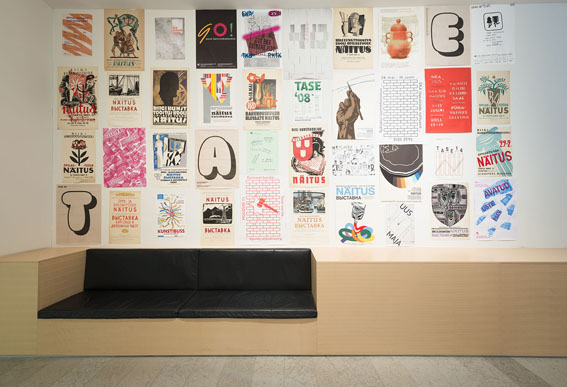
“From an Industrial Art School to an Academy of Arts:
100 years of art history in Tallin” (curator Mart Kalm).
Exhibition view in the Great Hall of Kumu Art Museum
5. XI 2014–22. II 2015,
photo by Stanislav Stepashko