The question of art and design is most certainly not a question of life and death. It is a question that interests the art circles of a small country fluctuating on the vague line between the welfare state and a state of failure. Why is it so fascinating for us? Probably because art and design in Estonia are constantly underfunded, so both cling to whatever little benefits they are able to muster from time to time, whether these benefits are material, such as scholarships or other quantifiable endowments, or social, such as the attention of the media or a broad circle of “likers”.
The (fashion?) collection “Longing For Sleep” by Marit Ilison attracted a lot of attention in the local media. How is it possible to achieve success in Estonia today, what strategies should be used if you want to reach international markets without large investments, when will fashion become art, and is it more profitable to work in Estonia or in international design circles when it comes to material success and branding? In one way or another all of these questions have been exemplified in Ilison’s case.
The answers to these questions are by no means hard to find: use social media, produce quality visual content or lookbooks, network with the right people at the right events, make the most of each story in the media. Also, it does not hurt if your designs look interesting and you do not stray too far from current trends – the cocoon coats have been centre stage for the last three or four seasons. Another sensible thing is to minimise production costs – the material is acquired for free and the cut is simple to reproduce.
Among other things the blanket coats remind you of the textile artists whose names remain unknown but nevertheless designed the blankets that have now been made into coats. As Ilison said in an interview for the Estonian newspaper Eesti Ekspress, “Longing For Sleep” owes a lot to the subtle charm of Soviet era designs. For some it may be recycling, for others cultural appropriation. It would be interesting to know what Ilison’s incidental collaborators think of the coats. Would they applaud or be disgruntled that their role has largely been disregarded? Is it ethical when culture is made into a trend, and when art is made at the expense of someone else’s way of seeing and interpreting the world, even if it has been channelled into a utilitarian article such as a blanket?
But let us come back to the products. The linings of the coats are decorated with Swarovski crystals, which are likely to irritate the wearer’s skin (moisturised as it is with exclusive lotions) even more than the coarse woollen cloth. Then again, there would probably be another layer between the coat and the skin – a dress; I would probably choose something from Open Ceremony, like a maxidress by Acne or Nina Donis. The Swarovski crystals are a symbol of the kitsch and vulgarity of post cold war Eastern Europe. The gold and glitter of the “new school” masks itself as tradition and craft and does not allow the wearer rest or sleep, it makes her go to nightclubs, looking for a foreign Adonis with a credit card that could fulfil her dreams. Or urges her to write projects to get funding for the EU. Or to find new ways to utilise old blankets. The shiny shards are like a symbol of the Eastern European determination that makes us go to Paris and London, to hustle and bustle until we can prove to those who have already established themselves that we have Skype, unspoiled nature and “we are just as good as you, please let us play”.
At Draakoni Gallery the coats were presented with glitter dresses, made using Indian textiles, and partly furry cow leather shoes. The shoes were a collaborative project between Ilison and Kristiina Nurk. The thing that counts most when it comes to clothes is who wears them. Without a person in the clothes, they seem somewhat unnerving, like a shell someone has been sucked out of. The absence of the wearer gives the clothes a power that allows them to communicate their own essence and also talk of the designer; they are no longer merely items to supplement the identities of fashionistas.
In addition to the exhibition at Draakoni the coats were displayed at the finale of the Hyrès fashion competition; a couple of years ago another Estonian designer, Ragne Kikas won the Première Vision prize there. The tour continued with London Fashion Week and the International Fashion Showcase 2014 exhibiting designs from outside the UK. The Estonian showcase displayed the works of Ilison, Jo Nurm, Kärt Põldman and Sille Sikmann; the exhibition was curated by Tanel Veenre and designed by Hannes Praks; the event was organised by the Estonian Design Centre. The Estonian exhibition was deemed the best at the entire showcase.
The coats have been featured in international fashion magazines and are being sold in two Italian boutiques. Ilison is one of the few Estonian fashion designers who has managed to take a small, yet significant step into the world of “big fashion”, or at least to the edge of it. So the discussions of whether it is fashion are actually not relevant. As an entrepreneur, Ilison is successful – considerably more successful than others working in the same field. If we consider her work design, it is a great example of the expectations of current design policy: recycling, a smart attitude and a conceptual approach. Ilison is a creative who has been able to link her creations with quantifiable characteristics, which is the goal and basis of the ideology behind the creative economy. Ilison knows how to share her success in the local media and that should be appreciated, as she is simultaneously signalling to her peers that it is possible to reach the pages of Vogue.
Forced to decide, I would say the “Longing For Sleep” collection is art. The value of these artefacts does not lie in their function, but in their concept. To be fair, these coats are ready-mades after all.
Anne Vetik is studying Art History (MA) at the Estonian Academy of Art and works in advertising.
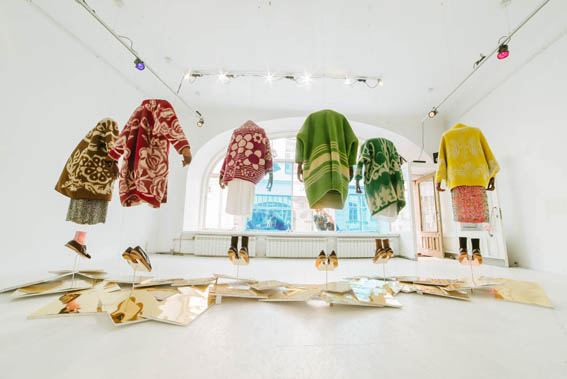
Exhibition view at Tallinn Art Hall,
photo by Tõnu Tunnel
Courtesy of the artist