When Markus Toompere proposed in spring 2013 that I curate the Tartu exhibition “Väljasõit rohelisse. Tartu 1860–2014” (Roadside Picnic. Tartu 1860–2014, 2. VIII–4. IX 2014) at the Tallinn Art Hall, the concept then was considerably more confrontational. As it says in the catalogue, the title was going to be “Drang nach Norden”. One of the first ideas for a new work, but which was not realised in the end, was to build Tõnis Paberit’s large Stone Bridge of briquettes on Vabaduse Square and set it alight at the opening. At the time, I was co-curating a survey show for the end of the year at the Tartu Art Museum, an exhibition that looked at the art scene in Tartu over the last quarter of a century, and consequently the exhibition planned for Tallinn was more conceptual and less of a survey show. But when the museum’s new director rejected this idea, because it did not match her programme, the plans for the Art Hall exhibition were pretty much underway and I did not want to start changing my idea.
At roughly the same time, at Saskia Kasemaa’s request, I was scanning her father Elmar Kits’ photo album, where quite by chance I came across staged preparatory photographs for Kits and Evald Okas’ large socialist realist magnum opus titled “Eesti punakaartlased Lenini ja Stalini juures” (The Estonian Red Guard with Lenin and Stalin, 1950–1951). By that time I had already planned to put earlier work together with contemporary work in each of the rooms, and then suddenly I had the idea of recreating these photographs with current-day Tartu artists – for Madis Katz to invite the Yevgeny Zolotkos and Jass Kaselaans together and produce a dramatic photographic series titled “Artists of Tartu Discussing Plans to Conquer Tallinn”, which would be a perfect title for the exhibition.
*
However, at some point Kits’ painting was replaced in my mind by another work. What if we were to recreate “Kunstiteoste arutelu ENSV Kunstnike Liidus” (Discussion of Art Works at the Artists’ Association of Estonian SSR, 1947) instead and display it in the same place where it was originally painted? But why photograph it? Tartu artists are, after all, the legacy of the Pallas School and cannot resist mucking about with paint. Bloody formalists! And naturally it would be a statement in itself, to come to the prime exhibition space in Tallinn, with a new interpretation of a socialistic realist work by an artist with Pallas values. It would be crazy to commission an artist in 2014 to paint a realistic group portrait. Quite daft!
In winter of that same year Peeter Krosmann painted a portrait of me as part of his project on bearded men. Krosmann is one of those Tartu artists, who is firmly stuck in the mud of the Emajõgi River and will never get out of it. I do not consider him to be the baton bearer of the old master portrait painters, but who else do we have. Anyway, my portrait was apparently the most successful of the works in the exhibition. The initial paralysis of the right side of the face was eventually got rid of and even though my partner thought the hobo looking out of the painting was quite unpleasant, the result was, after all, nicely realistic and even a bit psychological. Furthermore, I wanted someone to convey the repetitive impressionist play of colour flickering outside Kits’ windows, and therefore, Krosmann was the first and obvious choice to paint the work.
It was clear from the start that this painting was going to be “Kunstiteoste arutelu Tartu Kunstnike Liidus” (Discussion of Art Works at the Tartu Artists’ Association, 2014) and would be set in the large hall of the Tartu Art House. All that had to be decided was the question of who would be depicted. They had to be artists who represented a cross section of art in Tartu and be actively involved in the art scene, and unlike Kits’ original it had to include women.
Some choices were obvious – dapper Indrek Grigor in a light-coloured suit as Johannes Semper, Ilmar Kruusamäe leaning on the windowsill as Ferdi Sannamees. And of course the expected groupings – the threesome formed by Rauno Thomas Moss, Nadezhda Tshernoba and Kaire Nurk and then Yevgeny Zolotko cowering on his own in the back row (clearly a painted addition, like the unknown figure in the same position in the original). There were many other people active in the art scene in Tartu who were possible options (for example, Rael Artel, Imat Suumann or Indrek Hirv) and I will not try to claim that this was a deeply philosophical, political, conceptual or freemason-like conspiratorial selection, as many viewers have thought. It is fine by me if art historians discuss ad-infinitum on Facebook walls the extent of post-, alter- or hypermodernism.
*
To some extent the shortfalls in portraiture and technical weaknesses in the painting on show in Tallinn is due to Krosmann’s typical laziness as an artist, not to make use of the full six months allowed for the project, but to paint it all in the last few weeks. I knew this in advance when I commissioned the work and he had promised to work on the painting for the premier showing in Tartu for the end of year exhibition. But as a non-manual creator it is not my place to whinge. And Facebook immediately tagged Kiwa and Kaisa Eiche, when it saw them in the photograph of the painting, with me standing in front of it.
And by the way, I loved it when in the issue before-last of KUNST.EE, completely by chance and before the first showing of Krosmann’s work, the story by Maria-Kristiina Soomre, the art advisor at the Estonian Ministry of Culture, and her generation, was accompanied by a reproduction of the original. What are those bloody people in Tartu wandering around in the one-way streets of the Pallas school for; don’t they want to join the y-generation?
Peeter Talvistu is an art historian and works as librarian and archivist at the library and archive of the Tartu Art Museum.
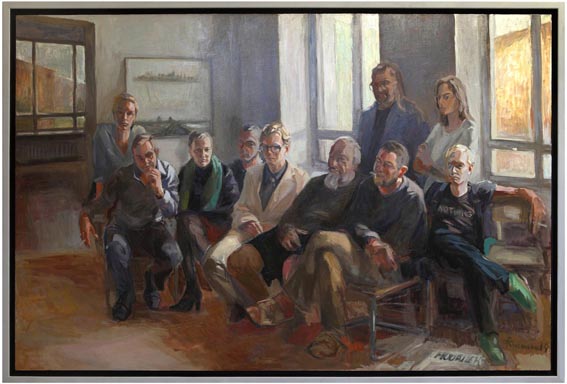
Peeter Krosmann
Discussion of Art Works
at the Tartu Artists’
Association
2014
oil on canvas
Courtesy of the artist,
photo by Malev Toom