28. VI–31. X 2014
The State Hermitage Museum, St Petersburg
Hannes (H): I don’t know “’ it’s been a month and the picture hasn’t become any brighter. Especially when thinking about the main exhibition in the General Staff building.
Anne (A): Well, let’s start, then, by pointing out that the enormous General Staff building just swallowed “Manifesta”!
H: Yes, it was indeed stifling at times. Then again, the confusion that prevailed during the press days was worse. There were builders everywhere: half of them working and making noise, the rest absorbed in watching the video programme. In a sense it’s, of course, only positive that someone other than the art professionals should be interested in modern art.
A: I “liked” the lifts that took people to closed floors with no exhibits. And what was also “good” was that there were no information signs, which makes it harder for the public to get out of the building and they have to see the whole exhibition.
H: The second floor, on the other hand, turned out to be almost a goldmine “’ you could finally find some decent works there.
A: Despite that, the whole thing was a completely random and lazy curatorial programme.
H: In places it still remained unclear to me what the larger goal was after all. A soft-core acknowledgement of world worries and local problems? As one theme I would point out fighting for marginalised historical narratives, which was done, for example, by Boris Mikhailov’s Maidan Square series of photographs (“The Theater of War, Second Act, Time Out”, 2014 – Ed.) and Wael Shawky’s (“Cabaret Crusades: The Path to Cairo”, 2012 – Ed.), which is a nice puppet animation about the First Crusade from the perspective of the “locals”. On the other hand, instead of marginalisation, at times the exhibition just falls into triviality. For example, why Matisse was part of the exhibition is a mystery to me.
A: Matisse was there so that some admirers of Fauvism would show up and buy a ticket. One of the more reasonable choices by the curator, as money makes the world go round. Although, Ilya Kabakov as a choice is, of course, something of a money shot. Then again, for me Kabakov is a suspicious trickster in this respect – on the one hand, he is literally a “groveller to the West” and on the other hand something like an eternal Soviet artist. He’s definitely not a Russian artist for me.
H: As we’re looking for recurring ideas, the cat and mouse theme made an appearance in quite a few places. Although I didn’t have it in me to watch those Bruce Nauman videos long enough to see animals. Generally speaking, the Hermitage animal paintings hall was more exciting.
A: With the “cat tunnel” installation (Erik van Lieshout, “The Basement”, 2014 “’ Ed.) I wouldn’t look for associations with Pussy Riot, but with the sites 9gag.com and cheezeburger.com “’ the long-standing employees of the Hermitage now finally also reached the top of the cat hierarchy, being digitally recorded and then labelled as cute. As well as catching mice, they will now be providing material for instagrammers all summer. The “broken house” (Thomas Hirschhorn, “Abschlag” (Deduction, 2014) “’ Ed.) seemed to be just a space filler. It’s great that there were books by Mikhail Bulgakov and a portrait of Anna Akhmatova up there, but superficial effect aside, nothing much was going on there.
H: Usually, I’ve liked Hirschhorn with his programme of occupying and “littering” space. This collapsing Soviet-era “office building” at the beginning of the exhibition (Ilya and Emilia Kabakov, “The Red Wagon”, 1991 “’ Ed.) also worked rather than not. But when I later read that there were some utopian Malevich & Co. on the walls inside there, the question hit me of whether we now need to take a pair binoculars to an exhibition. The end of modernism and the collapse and material Nachleben of a political system “’ this, then, seems to have been the other Big Idea.
A: The work was big, that’s for sure “’ at least it caught the eye. On the other hand, the Big Idea as such got lost in the large space. Timur Novikov in the General Staff building was perhaps the only one that worked perfectly. Tapestry suits a palace!
H: Indeed, it came across as a refreshing piece of applied art there; nice and decorative and not dominated by the room.
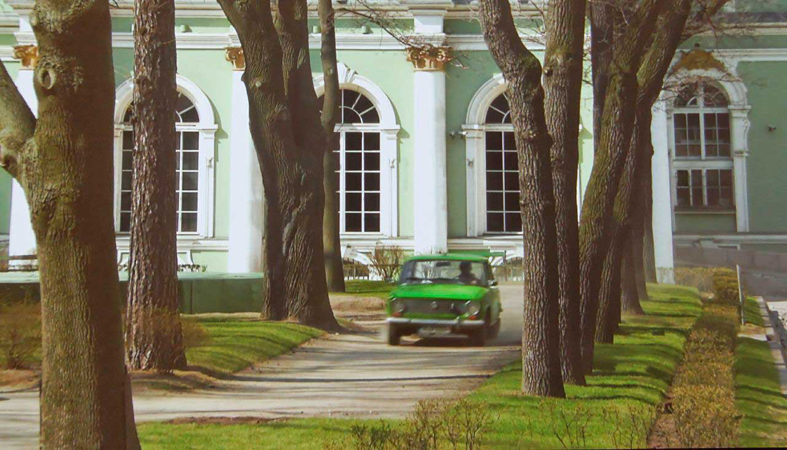
A: If one were to read this Zhiguli prank (Francis Alÿs, “Lada Kopeika Project”, 2014 “’ Ed.) as the personal journey of an average person, as it were, rather than the journey of Soviet modernism, the project would take on a humanist dimension, a plausibility, and become appealing as a result. Still, such a show-off, as if to say: look, we’re going mental here, hitting a tree in the courtyard of the Hermitage!
H: It is like a broader and more abstract interpretation of the 20th century that, as it were, hits a tree in this classicist courtyard. The end of the Enlightenment project? I would relate it to Hirschhorn, but, yes, I’m afraid that for visitors to the Hermitage, the Zhiguli will in the end remain an anomaly, the ultimate value of which will be an Instagram photo. Indeed, what was significant was the fact that all the works that were the least little bit provocative were in the General Staff building, as if hidden away from the general public.
A: To be honest, I don’t get why anyone should force themselves to look for good moments in a “Manifesta”? They are surely there, but this doesn’t change the fact that it is a banal heaping up of different works, some of them more striking and some more boring. Then again, perhaps the underlying idea was to make an exhibition that has already failed at the outset, to demonstrate the failure of eastern socialism? As if to say, see, we can’t even do a decent show in this brutish, gay-persecuting state.
H: In the end, the head curator blamed Russia, pointing out the absence of civil society.
A: Well, yes, in that case I guess there is no point at all to talk about the Winter Palace of the Hermitage. It’s great that one got to take a look at the room with the animal paintings and the cameos were also awesome “’ boy, did people have patience to sit around carving away in the old days.
H: What is ironic is that the Russians themselves made significantly better exhibitions. There sure were some gems in the parallel programme “’ it’s a pity I didn’t have the time to see it all. But the Cadet Corps shows were my favourites. The installation by Ivan Plusch (“ПроцеÑÑ Ð¿Ñ€Ð¾Ñ…Ð¾Ð¶Ð´ÐµÐ½Ð¸Ñ” (Process of Passing, 2012) “’ Ed.) with a red carpet in a hall that had once hosted Lenin was monumental in the best sense of the word. There’s no better way to capture the functioning of empires, which consist in oscillating between the absurd and the epic! And, of course, the aspect of stagedness. Every system that harbours imperialist ambitions needs its own Leni Riefenstahl. Another favourite of mine there was Mikhail Maximov’s “Мађь рожаеђ ођца мужа” (Mother Gives Birth to The Husband’s Father, 2012 “’ Ed.). A very grotesque and at the same time playful way to treat the problem of subjectivity and dignity in a society with the social problems typical of Russia (a negative birth rate, alcoholism, an obscure perspective for the future and so on).
A: Yes, the Cadet Corps building worked because they were not striving for the grand scale there, but remained at a graspable level and thanks to that both the individual works and the whole spoke to you. The carousel of fur hats by Igor Samolyot (“Вальє (Waltz, 2014) “’ Ed.) was without a doubt my favourite; it could be called Russian minimalism, dead sables going around in an empty room. Then again, if a sable doesn’t die, its ears will fall off in the freezing temperatures. So you have to make a choice, you see.
H: Yes, existential choices and a struggle for survival “’ next time the main organisers of “Manifesta”, it seems, should keep in mind that you can’t do a good show without dead sables.
Anne Vetik and Hannes Aava are master’s students at the Institute of Art History, Estonian Academy of Arts.
QUOTE CORNER:
“In a new section of the Hermitage, called the General Staff Building, curator Kasper König housed a dazzling selection of top names in contemporary art, such as Bruce Nauman, Francis Alÿs, Joseph Beuys, Wolfgang Tillmans and many others, all the way down to, or starting from, Henri Matisse, whose inclusion caused much confusion especially in the younger visitors. As in, why Matisse? After all, “Manifesta” has, since its inception, been dedicated to the creation of radical, new art and now, all of a sudden, some old man with his red paintings comes along. All this may have left an impression similar to when young people want to party but some geriatric has butted in, listens, shows interest, tends to talk “’ in a word, is disturbing. It would be better if he was not there. However, the Hermitage reputedly has the largest Matisse collection in the world and as the curator had initially been given the task of relating to the museum, why not rearrange contexts? [—]
Although for some, Matisse seemed to be real hard-core, curator König had taken a relatively safe path and divided the exhibition programme between all possible disciplines of art. One came across imposing architectural installations, slightly less imposing architectural installations, large-scale video art and slightly less large-scale video art, large-scale series of paintings and slightly less large-scale series of paintings and efforts to relate to the museum from the basement to the roof. There was a slight whiff of politics too, but just a slight one. [—]
In addition to the main programme, the city of St Petersburg is also hosting various urban space projects, which it is hoped will show precisely this really new art, which was missed at the main exhibition due to its relatively safe nature. As a first timer at “Manifesta”, listening to the stories from the local gurus on the way back from St Petersburg to Tallinn and drawing my conclusions, I was tempted to think that the whole thing had indeed degenerated and lost its teeth. Almost sentimentally, the Contemporary Art Museum of Estonia’s boss Anders Härm recalled the 2004 “Manifesta” in Ljubljana, where the scandalous Russian artists Brener and Schulz threw a performance, as a result of which three curators of the biennale had such a falling-out that they demonstratively refused to talk to each other at the press conference and it took great efforts to ensure that the event went on at all. “Ah, those were the times,” said Härm, airing a sigh.”
Janar Ala, “Manifesta 10” – katse olla diplomaatiline. – Postimees 1. VII 2014.
*
“I have a feeling that this year’s “Manifesta”, which was held basically a stone’s throw away from Estonia, will be remembered by the art people here as controversial, rather than uplifting. Too close to home, too close to the bone. And at the same time too far away to import the star glamour that would accompany “Manifesta” to these parts through some satellite event. As an analogy, we may assume that what is now going on in St Petersburg, would also happen here, if “Manifesta” were to take place in Estonia at some point in the future. That international stars would show up and the sales figures for accommodation providers and restaurants would soar, but the local artists would still feel somehow left out. That the question would arise, whether it would not have been more reasonable to use the money to do something big ourselves. That the grapes would turn out to be sourer than expected.
I have no wish to say anything bad about the art itself that was shown at “Manifesta” this time around. The Hermitage with its outright conservative image was opening a new modern art wing and, figuratively speaking, they were clever enough to order the catering from “Manifesta”, a travelling biennale with a 20-year-long history, which will guarantee the attention of the world’s art press on this gigantic renovation project.”
Andreas Trossek, Liiga lähedal, liiga kaugel. – Postimees 1. VII 2014.