“”Blood! No doubt about it!”
He stared at the red stain through his magnifying glass. Then he moved his pipe to the other side of his mouth and sighed. Of course it was blood. What else can you expect when you cut your thumb?”
Astrid Lindgren “Bill Bergson, Master Detective” (1946)
Edith Karlson’s three consecutive solo exhibitions “Drama Is In Your Head” (part I at Sur la Montagne gallery in Berlin 12.–26. II 2012; part II at Tallinn City Gallery 23.V–16. VI 2013; part III at Hobusepea Gallery 17. VII–5. VIII 2013) seem to accuse the audience with a slight arrogance: see what you want, think what you like—all the drama is only in your heads! Considering that what surrounds us is is a society of spectacle, the pedal should always be to the metal and “something interesting” should be happening all the time.
Drama as such is located outside good and evil, its primary measure is intensity, the fervour of the experience; however, a quality experience is increasingly harder to achieve as drama has become devalued and the process continues. Even though it is likely that visiting art exhibitions as entertainment (because drama is entertainment as well) is not as light as other forms of cultural consumption, it cannot yet be completely written off – sometimes it is also possible to find a thrill in art galleries. This is especially true as the drama can escalate from whatever, the triggers are cunning, covert and released unexpectedly; the occurrence of drama has nothing to do with its surroundings (at least from the point of view of the bystander).
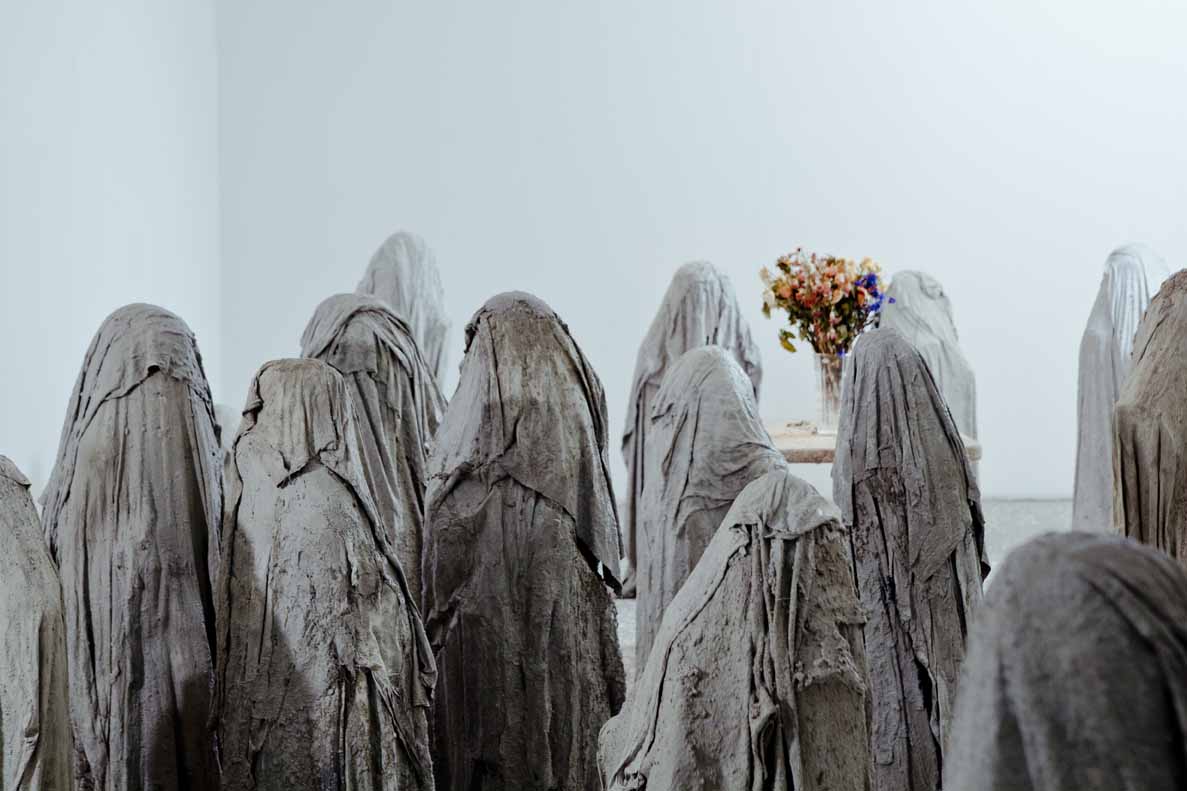
Edith Karlson
The Drama Is In Your Head II
Exhibition view at Tallinn City Gallery
Photo by Alan Proosa
Courtesy of the artist
Sculptor Karlson
In what Karlson has created, the viewer can see however much drama they like. The space is filled with rough sculptural forms, animal figures of some sort, hoses, large containers – the viewer can walk among the objects and the overall impression is raw and strong; everything is created in a vigorous flow without giving too much attention to detail. As the objects are exhibited in a gallery, the white cube balances their roughness, it presents them politely and makes them aesthetically enjoyable – using inexpensive, simple materials and the quality of robustness itself is a rebellion against a certain kind of tradition of sculpture but at the same time, it is still “a riot in your own back yard”.
It is obvious that Karlson knows the back yard well, which is also the reason she manages to stage different settings that seem to provoke certain types of expectations in regard to visiting an exhibition – that upon entering the gallery we are enveloped in a tempestuous experience and we instantly recognise what is going on. But the artist declines that notion, the author dies, the drama is in your head and in her head as well.
Dramas two and three
The second drama takes place in Tallinn City Gallery – the first room in the gallery is filled with statues that resemble waist-high columns draped in a baroque manner. Or ghosts. Even though they seem like a uniform mass, closer inspection reveals that each one is unique. At that particular moment there is a certain number of statues but it seems like the number could increase or decrease. In the centre of the back room of the gallery, there is a pile of pieces of concrete.
Karlson has created an impressive environment that can be felt (strolling around and between the statues), aesthetically enjoyed (the harmonies of form, composition and colour in regard to the gallery space and the sculptures) and interpreted (e.g. the “drama” that evolved inside the head of Aliina Astrova who wrote the exhibition’s introductory text about fearing ghosts as a child and the artist’s torment at becoming a woman). Everyone can focus on their particular experience, as the scene and its components are ambivalent and poetically abstract enough to do so.
Drama is a state that generates an enormous number of links that only barely touch upon the real. So, in creating it, considering all the complexities – the way constant stimulation has resulted in everything seeming blasé, the highly personal triggers, the secure nature of the gallery space and so on – is a huge challenge, and success is a compliment to the set director. But you cannot see inside the viewer’s head. Was the drama created? Or did they just shrug the exhibition off and remain indifferent? Some cause for concern.
It seems that Karlson, while preparing the next drama, started doubting, and for the third act, she brings back the recognisable forms and tactics known from her previous work. In the room upstairs we encounter a dinosaur with a continuous red fluid pouring from its mouth. Blood, no doubt about it! Downstairs we see a statue familiar from the second act of the exhibition that, instead of continuing in self-fulfilling inert silence, has been endowed with an asinine smiley face and gathered a few duck- or swan-like birds around it.
“Boredom unites, entertainment separates”
In addition to the dinosaur, the upper floor has a large mirror that reflects the whole scene; the entire floor downstairs has been covered with plaster that takes on a life of its own as it dries – it changes colour (fifty shades of grey?), it cracks and becomes increasingly fragile. Drama number three is comprised of more easily comprehensible elements and the component of entertainment is stronger than in drama number two.
But alongside the entertainment, the drama disappears; through easily recognisable triggers it is being channelled into too many heads at one time, it dies down, cools off and after having seen the exhibition, we can go home, entertained. The dramas born of boredom are significantly more fruitful – the lack of information forces us to keep pedalling at a standstill, which releases the multifaceted bundle of personal triggers that cannot be solved by any other visitor to the exhibition, and that makes walking away so much more difficult. The drama is made so delicious by the private experience, the personal “storm in a teacup” that, with its free flow of fantasy, could turn out to be an extremely creative state of mind. So, to conclude – the dramas seemingly caused by very little, by boredom, provide better entertainment than the overly abundant scenes that use universal triggers.
Less is bore and bore is more.
Maarin Mürk is a freelance art historian, critic, curator and the founder of the art criticism blog Artishok.