“What will become of us (if we don’t erect museums for ourselves)?”
Quote from the written component of Flo Kasearu’s master’s thesis
Flo Kasearu is definitely one of the more noteworthy younger generation artists, whose showing in recent years (exhibitions, projects in public spaces), and of course being dual winner in last year’s Köler Prize, has created high expectations for her work. Kasearu does not have a consistent theme or use a specific medium, but this makes her work all the more interesting – and even though one of the general mantras of the current era is for artists to be interdisciplinary, to work in multimedia and so forth, there are few artists who actually manage to pull it off. The “spoiled” public has begun to expect new surprises from Kasearu and she has managed to satisfy. Her own house museum is an ambitious step forward – an attempt to walk the knife-edge of “art and life” and ultimately to present herself as a whole anew. Furthermore, she has recently successfully defended a master’s thesis at the Estonian Academy of Arts, with Rael Artel as her supervisor, who also recently acquired a museum to run (i.e. Tartu Art Museum).
A topical collection
Considering the debate in the media last year about the status of contemporary art in our society, the founding of the Flo Kasearu House Museum (FKHM) undoubtedly hit a sore spot. Having to address the many practical issues that her various roles demanded of her (artist, property owner, home owner, mother), Kasearu provided a pointed comment on the role of the freelance artist. The museum’s low visitor threshold (read: essentially opening one’s home to strangers, the viewing of art in a non-standard environment, Kasearu’s direct approach in her role as guide, the recognition of “real” parts of the museum, but which are presented with a twist etc.) makes it possible to raise these issues ensuring they address a large target audience.
Kasearu’s work is characterised by her ability to capture the viewer on a “hook” using strong visual images (the series, “Unemployment Will Tear Us Apart”, 2010), irony and humour (video “Best Before is Over”, 2010) or a very personal openness (video “Estonian Dream”, 2011), which make it easy for the viewer to connect with the work and if they wish, to discover the more critical underlying subtext. The FKHM already has a fantastic “hook” in its slogan – “house museum of a living artist”. With its shift in expected categories it does all the work in advance – voilà! and the visitors are already excited. Finally, the viewer is allowed to be part of the unveiling of what has been a well-kept secret in western culture – the question of how these mythical unicorns (i.e. Great Creators) live. The idea of officially naming the house as some kind of “eternal” institution that releases the owner from the responsibility of having to manage it, gives hope to other legitimate owners in a similar situation as Kasearu, who are suddenly blessed in this way. Psychologists would no doubt approve of Kasearu as she actively addresses her fears, hopes and taboos, her “aural visual thinking”, which is possible to see as you move through the museum. After all, art has been a form of therapy.
As a whole, the FKHM is like a compilation album with something for everyone and this impression is further emphasised by the “best-of” style permanent exhibition of Kasearu’s work from 2011–2013. Some songs are very good, some fantastic, while with others it is difficult to understand how they made it into the final selection. But despite everything, you work through the whole compilation. Not all the jokes in the FKHM are witty either. Nor are all the parts of the exhibition apt or shrewd; for example, combining the library and the WC is too easy, and even though the whole museum is based on the act of proclaiming (“I say that I have earned immortalisation”), sometimes the overuse of such words as “musealisation” goes too far.
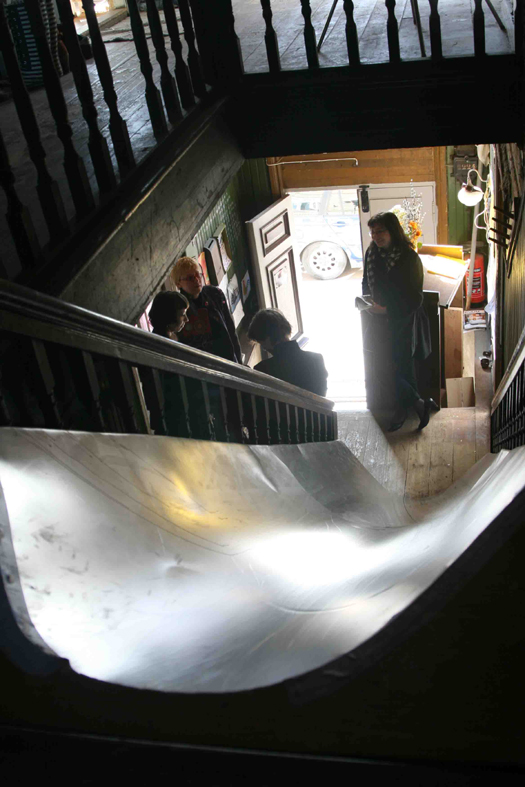
Flo Kasearu
Ars longa, vita brevis est
2013
Installation
Photo: Piia Ruber
Courtesy of Flo Kasearu House Museum
Taking the reins
Nevertheless, big words are necessary because naming something also creates it. FKHM fits neatly into the tradition of artist-run spaces – the idea of not wanting to submit to the prescribed rules of the art world, the artist endeavours to control her creative processes, her opportunities for expression and the preservation of these for the future, or at the very least to draw attention to these issues. Many grassroots initiatives have started out as one-off evening events, where the artist opens up their studio (where they also live), or someone’s apartment is used as the space for a project and so forth. The boundaries between public and private, art and life become fuzzy – as is the case with FKHM. In the long run, many such initiatives simply run their course or become part of the mainstream. However, the phenomenon that made it possible for the undefined events that took place in artist-run spaces in the 1960s and 1970s to reach the institutional resources of the art world was the 1990s trend “relational aesthetics”. Despite the problematics of this slogan, it legitimised all types of social situations, transient collaborations and so forth, and made it possible for the boundaries of art to extend and for FKHM to be born into that specific niche.
With FKHM, Kasearu does not seek any special theoretical “slot”, but self-initiated practices have never stood out as being particularly self-critical nor have they attempted to seek wider contextualisation. Having been born out of specific needs and shortfalls, they are characterised by a certain feverishness in the realisation of the idea. Later there will be time to reflect on what has been done, especially because most of these initiatives, by nature, are short term, ending when the energy, enthusiasm and resources come to an end. Or in more cognisant cases, when the time is right – because they do not want to become like the institutions, which they initially wanted to provide something alternative or contrary to.
FKHM and the Other
The impetus behind FKHM was also to contest actual realisations and shortfalls and this is apparently based on a fairly clichéd idea, rhetorical and practical, of what a museum is (somewhere there is even mention of spider webs). In response to the threat from the entertainment industry, and also artist-run spaces, traditional institutions have become more open, they include the public more, they are more flexible, and in many cases it is difficult to distinguish between ground roots initiatives and institutions that were created from on high, as it were. So, in this situation what else can we rely on, if not prejudice?
It is interesting that even though Kasearu has expressed the desire to challenge both the stability and safety of her home life and the theme of visiting exhibitions, in practice the FKHM appears very safe. Everything on show at FKHM is strictly controlled – by Flo Kasearu. This is after all Flo Kasearu’s house museum. For the viewer it is simply an opportunity to submit to a different kind of solution, not to intervene or influence it. Kasearu has said that she did have ideas in connection with the given building, that would have been of a more cooperative nature, but the resulting project is one where the activities of the whole building conform to Kasearu’s vision (for example, the project space Tiib, with its uncategorisable nature seemed like a much bigger challenge). Was it possible for any of the inhabitants of the building to refuse to be “musealised”? The short answer is of course yes, because doors can be closed and so on. But usually such undertakings by small groups are based on emotional participation and unwritten rules. Anyone who does not “get in with” the dominant spirit would be a stick-in-the-mud and such stigmas would make it difficult not play along with the FKHM.
In addition, despite initially appearing as a grassroots venture, the FKHM is more of an authoritarian venture, reminiscent of an organisation created from above, and the difficulties in maintaining its position are also somewhat surprising. Initiatives like FKHM are affected by the “system’s” interest in acquiring new blood and innovative solutions. To rely on the hope that the house would be in constant flux and only as much will be done as there is energy, will not save the it from becoming integrated. Kasearu, on the one hand, criticises art policy in Estonia, which has created a precarious position for the freelance artist, and on the other hand, announces that FKHM makes a contribution to the diversity of the valuable atmosphere of the suburb of Pelgulinn and also to the national Year of Cultural Heritage. She manages to critically observe her role as an artist in the current context, but then “tongue in cheek” presents her performative “musealogical” position. It is not clear how important the critical analysis of the FKHM is for her, as a reactive venture nor, for example, how the venture contributes to the gentrification of the area. Of course, the hipsters of the suburb of Kalamaja love FKHM, because it is alternative, lo-fi, DIY and so on. But let us not forget that even though FKHM constantly presents (albeit with a sense of humour) the complicated choices and difficult situation of the contemporary artist, the museum has come about as a result of support from institutional systems; that is, with help from the Estonian Cultural Endowment and Erasmus trainees.
Art and… (what next?)
This uncertain position is inevitable because despite the frequent use of such words as “museum” and “musealisation” the process of becoming a museum goes no further than yet another art project by Flo Kasearu, which means it remains in a relatively safe zone, where failure is not really possible. In a sense it is completely impossible to criticise the FKHM because the game played between traditional museum rhetoric and paraphernalia has already been proclaimed as homemade, with a tongue-in-cheek sense of humour. In other words, whatever the FKHM is or is not, that is exactly how it is meant to be. Of course, there is always more that could be done to make it more like a “real” museum. For example, one sign in the museum suggests that instead of a mouse there might be a rat under the stairs, since apparently deserving museum employees have the chance to be awarded the Museum Rat Award. Hopefully, Temnikova & Kasela Gallery, which recently represented work from the FKHM collection at the “Loop” video fair in Barcelona, has a consignment document with the museum’s logo on it.
But actually it makes no difference. At present, it seems that the most important thing about the FKHM has already happened – it has been created. The joke as been made and we have all had a good laugh. The future of the museum is probably similar to the ordinary house museums that Kasearu has criticised – you visit once, and there is not much reason to go again. Even though the FKHM is promoted as a “living museum”, where the everyday should continue to contribute something new, people’s everyday lives are not really that interesting – even that of a promising young artist.
If Kasearu wanted to carry out an art project called “Flo Kasearu’s House Museum”, then it has been very successful. It is, no doubt, one of the wittiest initiatives of recent times, one that touches many social and personal issues, and issues currently topical in the art world. But with these kinds of projects, which flirt with “real life” more than the average, one question remains – would she manage if she wanted to move outside the safe boundaries of the art project to operate for longer than a half-year Cultural Endowment stipend allows? Why should Kasearu, as a freelance artist, not try to create her own institution, one which ensures control over her creative processes and provides a means for exposure now and in the future? Why should the FKHM not try to become a real employer, with a pension scheme and so on? But after the initial enthusiasm doubt creeps in. Does the FKHM, with its transient impetuousness not confirm the helplessness of the artist. Though artists have the ability to comment and make reference to social attitudes, when it comes to actually taking steps to improve the situation, it falls on the shoulders of someone else, someone outside the art world, because “we are busy making art”. So, again – what will become of us (if we don’t make our own house museums)?
Maarin Mürk is a freelance art theorist, critic and curator and founder of the art criticism platform Artishok. She was also the opponent for Flo Kasearu’s master thesis.
CV
“On 24 April at 7 pm, the artist Flo Kasearu will open her house museum at 8 Pebre Street, Pelgulinn. Flo Kasearu’s culturally important house museum is located in a cosy wooden house on a quiet side street in Pelgulinn. The artist will open her home to visitors, who then have the opportunity to be part of the exciting creative atmosphere of her home studio. The art works, artefacts and archive are on permanent display in the eight apartments, attic and cellar. The building itself forms the core of the exhibition, where the young artist addresses the concepts of home, homelessness, homesickness and emotions connected with being a homeowner. In museum’s garden has an open air installation and a craft corner for children. The opening of the museum coincides with the artist’s birthday. Flo Kasearu was born in 1985 in Pärnu. From 2004–2008 she studied painting and from 2008–2011 photography at the Estonian Academy of Arts. In spite of her youth, she has participated in many group exhibitions, and worked with curators such as Liz Wells, Phillip Van den Bossche, Rael Artel, Margit Säde Lehni, Eha Komissarov and others. Her work is included in the collections of Kumu Art Museum and Tartu Art Museum. In 2012, Flo Kasearu won the Köler Prize and at the same exhibition the People’s Prize.”
Source: FKHM press release.