The Ukrainian-born artist Boris Mikhailov has a series of photographs titled “КраÑнає (Red) (1968–1975) that shows the red of the flag of the communist empire in everyday life: flags, cardigans, lips, haemorrhoids, flowers, book covers, cars, furniture and so on. Although Marge Monko’s solo exhibition “How to Wear Red?” makes no direct reference to Mikhailov, his photographs do create a context for the show in the post-communist region of the world. Today, the former propaganda colour red has partly lost its political memory when it comes to communism, yet it sometimes does get politicised, even if only as a provocation; for example, in the series of public platforms “Public Preparations” organised by the curator of Monko’s exhibition, Rael Artel.
In this exhibition in Tartu, the colour red is primarily an element of decoration, although the works do address communist “red” economics and its consequences. Characteristic of Monko’s work, the exhibition consists of rather intellectual discussions inclining towards activism that explore the politics of work and always include feminist views, rooted in ideas dealing with the subjection of women and their role in society. Monko’s work might be more appreciated by audiences if its aesthetic language were not so complex. Still, although her aesthetics are as strict as the image of the “true Estonian woman” once was, her work is full of charming witticisms despite exploring serious themes.
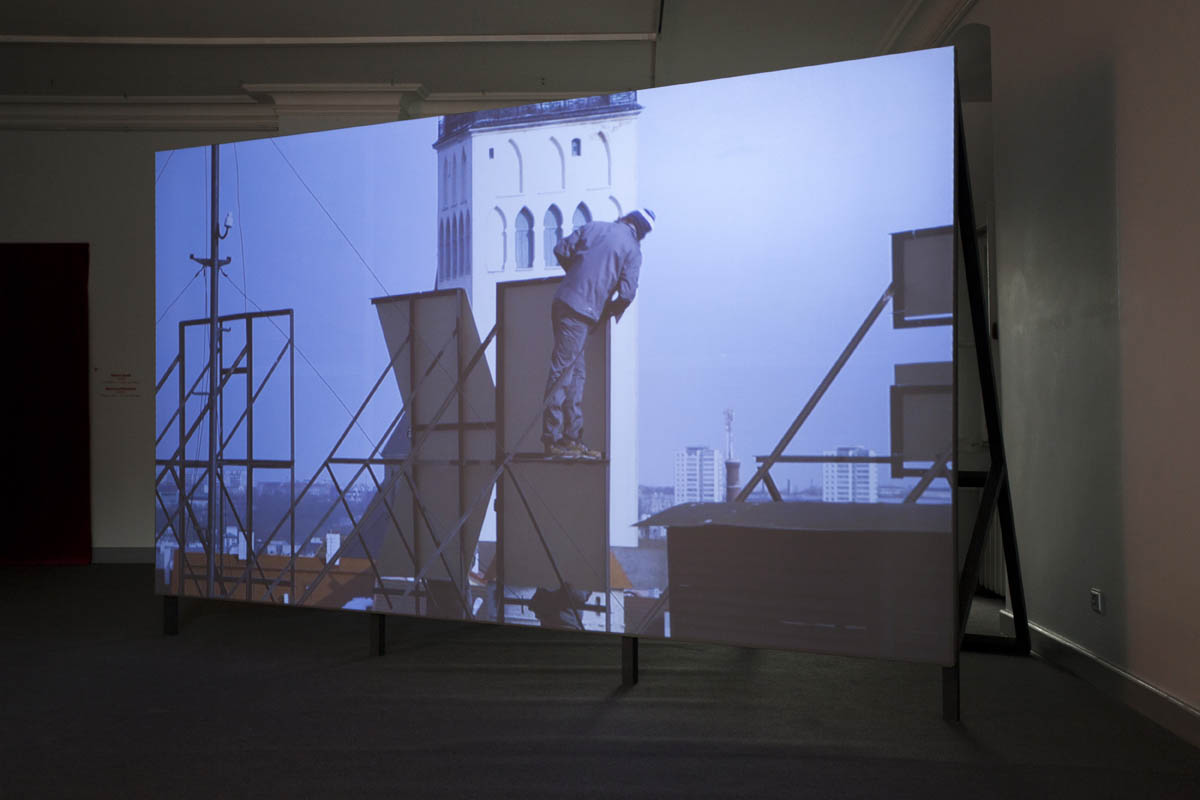
Exhibition view at Tartu Art Museum
Photo by Anu Vahtra
Courtesy of the artist
Tallinn and Kreenholm
The exhibition starts with the video installation “Punane koit” (Red dawn) (2013). The sign “Red Dawn” is reattached to structures that have remained on the roof of the Suva hosiery factory – the white letters are bathed in red light and then filmed from the Patkuli stairs at night, the sea in the background. In the museum, the video is projected onto structures similar to those on the factory roof. It is a clear and flawless formal association that should instantly draw the visitor’s attention like a whistle. It is likely that the restoration of the old “Red Dawn” sign is more affectionately recognised by older members of the audience. I, however, found it somewhat puzzling that an artist who always expects critical thinking and thorough argumentation from her audience really believes – as stated in the interview in the booklet accompanying the exhibition – that the restoration of the sign could actually lead to an exchange between members of the government and the history of the factory, due to the fact that Toompea hill, where the seat of the Estonian government and parliament is located, affords the best view of the factory.
At the same time, the “Red Dawn” sign, almost aflame, is a breath-taking and poetic prologue to the exhibition that continues with previously seen works – the film “Nora õed” (Nora’s Sisters) made using propaganda photographs taken inside the Kreenholm factory, and the posters “Ma ei söö lilli” (I don’t eat flowers) (2011). In the exhibition booklet, the curator and the artist discuss almost all of Monko’s works presented in her various exhibitions, and this establishes the theoretical framework for the show. The best known series of photographs “Manufaktuuri langus” (The Fall of the Manufacture) (2009), depicting the abandoned industrial complex, seems like a voiceless scream: everyone has unexpectedly left, the machinery is still fit for production, there are sculptures of working women still standing in the vicinity, the rubbish bins still contained the rolls that once held fabric waiting to be hauled away, and so on. These are not just beautiful intense pictures that have been fine-tuned to the extreme; just like Monko, they also ask: “What happened? Where did everyone go?” Upon deeper reflection, the question arises “what happened to the weavers, since they had no other factories to go to”. Kreenholm was the largest factory in the region and it was closed down in the 1990s when light industry moved to Asia.
Monko’s exhibition ends with the video, now in two parts “Foorum I ja II” (Forum I and II) (2009). In the first part, the Estonian TV show “Foorum”, which only included Estonian-speaking male guests, is re-enacted in Russian using amateur actresses. In the second part, they abandon their previous roles and discuss their actual experiences as older Russian-speaking women in Estonia who have lost their jobs.
Emancipation and temperament
In introduction to a discussion of Marge Monko’s artistic language, it must be said that as in “The Fall of the Manufacture”, the confusing and extreme sense of form can also be seen in the film “Shaken Not Stirred” (2010), which tells the story of class and how rich and poor but also powerful women are still governed by a bunch (sic!) of men. Insiders in the art world mostly say the film is clumsy and the script is slightly boring and does not contribute anything new. But is that not exactly what Monko is playing with?
It depicts super diligent women in great physical shape who work all the time, support their husbands until the men die or leave. Young women stay at home with the children, work and study at the same time, while their men are fooling around. No, we are not looking to blame anyone – men do not have it easier in the web of their masculine crises. But as a respectable second-wave feminist, Monko has not discussed that theme since 2007. As male authors throughout history have created a plethora of vacuous female characters, feminists usually try not to shape and depict the male emotional landscape according to their own understanding. So, in this particular film, the man is more of an illustration and a metaphor is like a well-rounded character.
The aesthetics of the film “Shaken Not Stirred” tuned-to-perfection, boring yet intense, says a lot – simultaneously reflecting the artist’s subjective point of view on the “state of things” and her position in the art world. But what should be said about the new series “8 tundi” (8 Hours) (2013), which presents a clean-cut collage of slogans from 20th century working class feminism and photographs from the current Suva hosiery factory, also known as Punane Koit (Red Dawn) during the Soviet era, and before that as Rauaniit (Iron Thread) during the first period of the Estonian Republic. In the catalogue, Monko points out that the photographs taken during the first Estonian Republic at the beginning of the 20th century exhibit a certain kind of restraint and steadfastness, yet those workers also went on strike in protest against layoffs and low wages. The photographs in “8 tundi” (8 Hours) stand against the remarkably more dynamic pictures of “Nora õed” (Nora’s Sisters), both within the exhibition space, and in the interview conducted with the artist.
The workers from the time of the republic were “Estonia’s own rustics” with some more cultured Baltic Germans; among “Nora’s sisters”, however, we see the imported “consecrated strike workers” such as Leida Kim alongside other politically active women workers whose temperament seems to have changed compared to workers from 30 years ago. Is this series meant as a question about the Estonian temperament? Or should the slogans in those pictures such as “We want bread and flowers too!” be more recognisable for contemporary audiences? The current quietly fading working class movement in Estonia does not seem to consider the subjection of women much, with the exception of the liberalist support for child rearing that applies to everyone.
Young people and politics
Another paradox in the exhibition arises from Monko’s new series “Vaba armastus” (Free Love) (2013), where photographed girls from Tartu who have just graduated from secondary school. The gaze of the girls in the pictures is rather determined but also aloof. They are not looking into the camera. Their gaze is directed towards their parents and boyfriends. From all the photographs the artist took, she selected the most passive. In the catalogue, the artist states that the young people of today are worryingly politically passive. That is also the reason she has juxtaposed the photographs and the article “Free Love” from 1905 by the Estonian statesman Jaan Tõnisson, where the future head of state uses conservative gibberish to grumble that the girls from the Pushkin high school have gotten completely out of hand – they unabashedly socialise with revolutionary Russian students without thinking about marriage and other things that are “important in terms of a woman’s honour”. Further, Tõnisson mocks the learnedness of the young women and their mental capacity. Some of the young women, like Alma Ostra-Oinas, were expelled after the publication of the article. Yet, now we recognise her as a politician and activist of key importance in Estonia in the first half of the 20th century.
Monko’s “Free Love” is one of the first Estonian works of art in the 21st century that discusses the little-mentioned 1905 revolution that is one of the most important landmarks in terms of Estonian intellectual history. However, Monko’s disapproving glance towards the younger generation is confusing, she seems to imply that they (read: we) are not political enough. But should one really expect Estonians to take political stances when a culture of staying true to one’s political views is non-existent? The politicians from the Estonian Centre Party join the Reform Party; the ‘revealers of the truth’ tell lies exactly like the people they are exposing. And when have we seen any kind of general political activism before/after the Russian troops left the country in 1994? Fifty thousand Estonians have left the country to work in Finland, and the number who have left to fulfil their potential elsewhere is just as high. The only political countermeasure to stem the outflow of workforce and inhabitants is the social campaign “Bringing the Talented Home”.
Estonia is not involved in making world politics and the common understanding among the people is that in case of trouble there is no one to help us. Monko’s work is fashionably retro, glancing back at the 20th century. She discusses issues that have been problematized for more than a century; at the same time, technology has developed rapidly and solved or maybe changed the nature of those issues, but that is something the artist does not address. In other words, Monko’s work is not directed towards changing the future but stays true to analysing archival materials. The artist is looking into the past for the first inklings of today’s political culture, and forgotten stories that could drive people today, and especially women, to reflect on their lives through the policies of the state and be less bothered with the insignificant and superficial issues promoted by our everyday visual culture.
Deliberation and intellect
To conclude, it should be noted that museums do not organise solo shows for female artists very often, and Marge Monko’s powerful exhibition proves that the format of the solo show has not yet lost its force. The question “How to wear red?” finds an interesting answer in the show: socialist views are not always radical, activist or propagandist – they can also be carefully considered and intellectual.
Even though the links in some of Monko’s pieces are not always clearly presented, and the viewer who does not know “everything” may resort to simplified interpretations, the exhibition as a whole is well structured. Particularly interesting is the juxtaposition of four different orders of state: Estonia during the 1905 revolution and the tsarist period, the factory Rauaniit photographed between 1919 and 1934 during the first republic, the Soviet propaganda photographs of the Kreenholm factory from the 1950s and 1960s, the local Russian women of today re-enacting the talk show “Foorum”, and finally, today’s high school graduates. The way a person wears red (their mentality) is really up to the person themselves, but the exhibition confirms the brevity of a century in this part of the world and reassures that the situation could rapidly change again.
Rebeka Põldsam is a project manager and curator at the Centre for Contemporary Arts Estonia.